

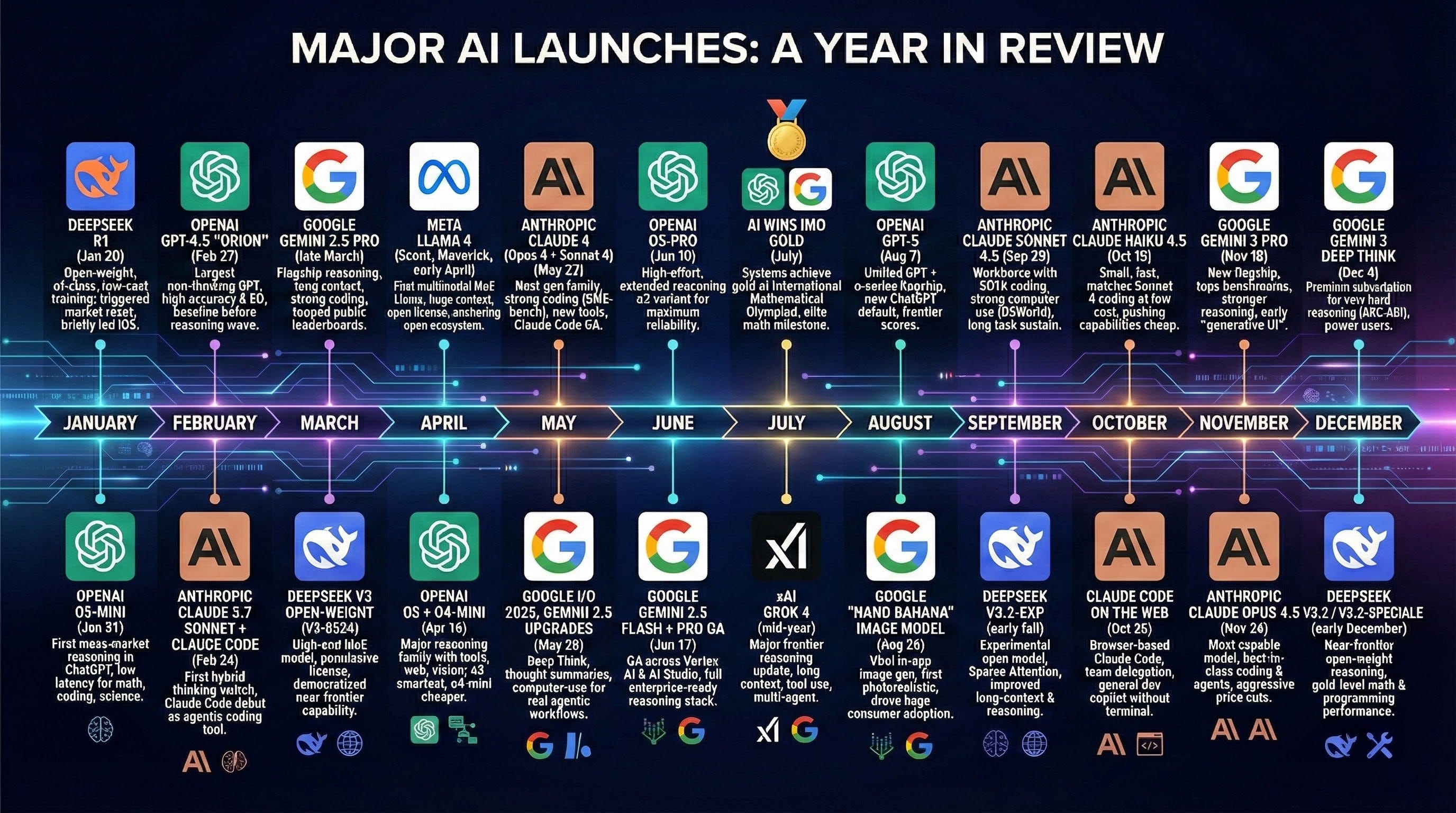
2025: The Year AI Stopped Being a Toy
TL;DR: 2025 saw AI shift from impressive demos to real work. DeepSeek proved frontier models don’t require frontier budgets. Reasoning capabilities went mainstream. Agentic tools started doing actual tasks. And by December, we had multiple models that can genuinely handle complex, multi-step work. If you’ve been waiting to see what AI can really do, this was the year the answer got clear.
You know that feeling when you step away from your inbox for a few days and come back to chaos? That’s what tracking AI felt like this year. Every time I turned around, someone had launched something that would have been headline news six months earlier.
Here’s what made 2025 different: AI stopped being a parlor trick and started being a tool you could actually hand work to. Not “summarize this email” work. Real work. The kind that used to require hiring someone.
Let me walk you through the moments that mattered most.
January Set the Tone
The year opened with DeepSeek R1 dropping like a bomb on January 20th. This Chinese lab released a reasoning model that matched OpenAI’s best, trained for a fraction of the cost. It briefly knocked ChatGPT off the top of the iOS charts.
Why does that matter to you? Because it proved frontier AI doesn’t require frontier budgets. The “only big tech can play” narrative died in week three of January. That has massive implications for competition, for pricing, and for what your vendors will offer you by next year.
Eleven days later, OpenAI responded with o3-mini, putting reasoning capabilities in the free tier of ChatGPT. The democratization race was on.
February Through April: The Reasoning Wave
February brought Claude 3.7 Sonnet with something genuinely new: a switch between instant and extended thinking. Ask it a quick question, get a quick answer. Ask it something hard, and it’ll actually think longer. This sounds small until you realize it’s the difference between a calculator and someone who can work through a problem.
More importantly, Anthropic launched Claude Code. A tool that doesn’t just write code snippets but actually works in your terminal like a junior developer. This was the first real hint that AI could do tasks, not just generate text.
By April, OpenAI released o3 and o4-mini with tool use, web browsing, and vision built in. The models could now look things up, use external tools, and reason about images. Each capability alone isn’t revolutionary. Combined, they’re something new entirely.
May: The Enterprise Gets Real
Google I/O 2025 brought Gemini 2.5 upgrades with “Deep Think” mode and computer-use capabilities. Anthropic countered with Claude 4, featuring Opus 4 and Sonnet 4, with dramatically better coding benchmarks and their Files API.
Here’s what I mean by “better coding”: Claude 4 hit scores on SWE-bench (a standard test where AI has to fix real bugs in real codebases) that would have seemed impossible a year ago. We moved from “AI can write a function” to “AI can navigate a codebase and fix a bug.”
Both Google and Anthropic made their agentic tools enterprise-ready. This wasn’t research anymore. This was infrastructure.
July: The Symbolic Moment
In July, both OpenAI and Google systems won gold medals at the International Mathematical Olympiad. AI competing against the best young math minds on the planet and winning.
I’m not suggesting you need AI to solve olympiad problems. But this crossed a line that matters: these tests require genuine reasoning, not pattern matching. When critics said “AI can’t really think,” they often pointed to complex math as proof. That argument got a lot harder to make in July.
August: Consolidation
OpenAI released GPT-5 on August 7th, and it did something smart: merged their GPT and o-series into a single model. No more choosing between “creative GPT” and “reasoning o-model.” One model that can do both.
This matters for adoption. Simpler is better. One tool that handles everything reduces friction, reduces training time, reduces the “which AI do I use for this?” paralysis that’s slowing teams down.
The Fall Push
September through December felt like everyone sprinting for the finish line.
Anthropic dropped Claude Sonnet 4.5 in September with even better coding and the ability to sustain very long tasks. In October, they made Claude Code available in the browser, so teams could use it without touching a terminal.
November saw two major moves: Google’s Gemini 3 Pro jumped to the top of public benchmarks, and Anthropic released Claude Opus 4.5 with aggressive price cuts. The price cuts matter as much as the capabilities. When frontier AI costs drop 50-80%, use cases that didn’t pencil out suddenly do.
December opened with Google’s Gemini 3 Deep Think for hard reasoning tasks and DeepSeek releasing V3.2, another open-weight model hitting near-frontier performance. We have a few weeks left in the year, and there’s still time for a December surprise!
What This Means for Your Business
Three things stand out from this year:
The first is that reasoning models are the new baseline. AI that can actually think through problems, use tools, and work autonomously is now table stakes. If your AI strategy assumes “fancy autocomplete,” you’re behind.
The second is the open-source pressure cooker. DeepSeek and Meta (with Llama 4) keep releasing powerful open models. This puts price pressure on everyone and gives you options. Don’t get locked in.
The third is that agentic AI is real but early. Tools like Claude Code can genuinely do work. But they need supervision. Think capable intern, not autonomous employee. The productivity gains are real. The “set it and forget it” dream is still premature.
What to Do Monday Morning
Pick one reasoning-capable model (GPT-5.1, Claude Opus 4.5, or Gemini 3 Pro) and run your hardest real task through it. See what it can actually handle.
Audit your AI spend. With prices dropping this fast, renegotiate any contracts older than six months.
Identify one workflow where an agentic tool could do supervised work. Start small. A code review process, a research task, a document analysis pipeline.
Brief your leadership team on the capability jump. Many executives still think of AI as 2023-era ChatGPT. That mental model is dangerously outdated.
2025 was the year AI grew up. Not perfect. Not autonomous. But genuinely useful in ways that change how work gets done.
The question isn’t whether to use these tools anymore. It’s how fast you can figure out where they fit.
I write these pieces for one reason. Most leaders do not need another timeline of who released what; they need someone who will sit next to them, look at how their team actually uses AI today, and say, “Here is where reasoning models change your workflow, here is where agentic tools are ready for supervised deployment, and here is what’s still too early to bet on.”
If you want help sorting that out for your company, reply to this or email me at steve@intelligencebyintent.com. Tell me what your team is building, which AI tools you’re already paying for, and where work is bottlenecking. I will tell you which of this year’s capability jumps applies to your situation, what I would test first, and whether it even makes sense for us to do anything beyond that first experiment.