

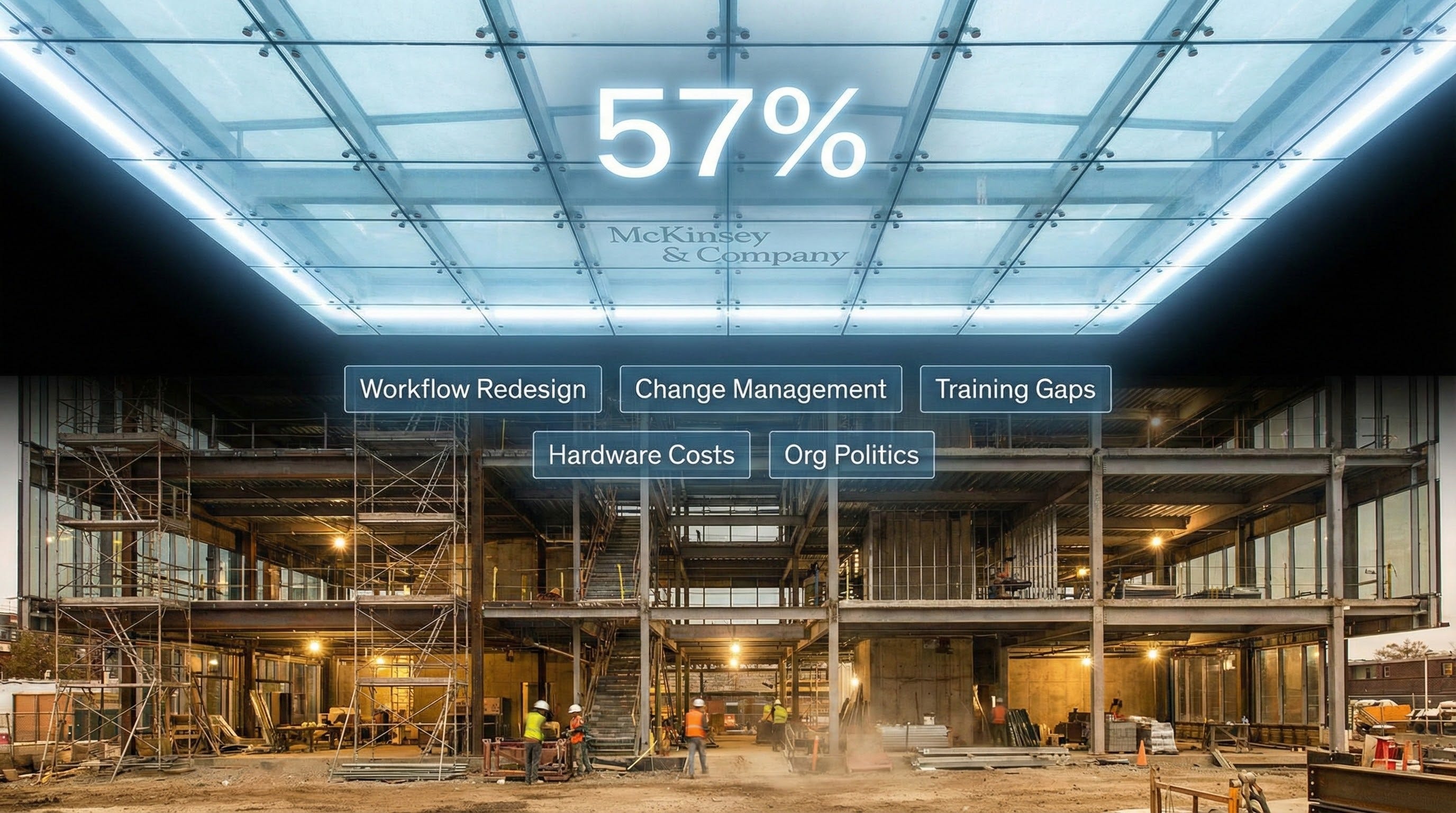
McKinsey says 57% of work hours could be automated. What does that actually mean for your business?
Your feeds are probably full of hot takes right now.
“Half of jobs gone.”
“Robots will do most of the work.”
All of it traces back to a new McKinsey Global Institute report, Agents, robots, and us: Skill partnerships in the age of AI, which says current technology could, in theory, automate activities that account for 57% of US work hours.
If you run a firm or a business unit, that number hits two emotions at once: anxiety and skepticism.
Here is how I’d read it as an operator, not a headline writer.
TL;DR: McKinsey is not saying 57% of jobs vanish. They are saying that if you break work into activities (tasks), more than half of those hours are technically automatable with tools that exist today, especially digital, rules-based work. Turning that ceiling into reality will take years of workflow redesign, capital, and change management. The smart move is not to plan for mass layoffs, but to start reorganizing work so AI handles repeatable tasks and your people move toward judgment, client trust, and new revenue.
The headline is about tasks, not jobs
Let’s start with what McKinsey actually measured.
They did not ask, “Can AI replace accountants, lawyers, actuaries, or project managers?” They asked a simpler, more practical question:
For each activity inside a job, could software agents or robots do this at or above human level with today’s tools?
When they roll that up, they get roughly:
About 44% of US work hours tied to nonphysical tasks that software agents could, in theory, perform.
Another 13% of hours tied to physical tasks that some type of robot could plausibly handle.
That is where the 57% comes from.
Here is what it is not:
It is not a prediction that 57% of workers are laid off.
It is not saying this happens next year.
It is not even a forecast. McKinsey calls it “technical automation potential,” which is a polite way of saying, “this is the ceiling if you did everything right for a long time.”
A lot of the commentary online quietly skips that nuance and jumps straight to “jobs lost.” If you read the report itself, the tone is very different. It focuses on how work is reassembled around people plus machines, not people versus machines. Most roles change more than they disappear.
That distinction matters a lot if you are responsible for hiring plans, training budgets, and client delivery.
Where automation actually bites: inside the job
Here is a more useful way to think about the 57% headline.
Every job in your firm is a bundle of tasks. Some are very automatable. Some are not. McKinsey splits them broadly into three groups.
Digital, rules-based work
This is the copy-paste, the “check three systems and update a fourth,” the standard first draft, the basic analysis, the status email.
This is where AI agents already shine, and it is where a huge chunk of the 44% sits. If you can explain the steps in plain language, a machine can often learn to help or even run them.
Predictable physical work
Moving boxes. Simple machine operations. Routine inspection tasks.
Robots can already do a slice of this, and will do more as costs drop and hardware improves. That is the 13%.
Human-centric work
Reading a room. Negotiating a deal. Calming a frustrated client. Coaching a struggling team member. Making a judgment call when the data is messy and someone’s reputation is on the line.
This is still hard to hand off to machines in any serious organization with real stakes. And it is a big share of total work.
So when you hear “57% of tasks,” what it really signals is task unbundling inside existing jobs.
A junior lawyer may see 40% of their hours, the research and first-draft work, handled by an AI agent, but their role in strategy, negotiation, and client trust becomes even more important.
A RevOps analyst may stop rebuilding the same dashboard and instead focus on asking better questions, validating data, and sitting with business leaders to interpret what the numbers mean.
A customer service team may let agents handle straightforward tickets and free human reps to focus on high-value saves and relationship-building.
The job does not vanish. The mix of tasks inside the job shifts. Skills survive. Tasks move.
Timelines: what has to happen for 57% to become real
If you take the 57% at face value, you might picture a near future where half of all work is automated away.
That is not how these transitions work in real organizations.
There are at least three big constraints between “could” and “actually happening.”
1. Workflow redesign, not just tool installs
The 57% figure assumes you fully redesign workflows so that people, agents, and robots each handle the steps they are best at.
That is not “turn on the new AI feature in a SaaS product and call it a day.”
It means stepping back and rebuilding processes end to end: intake, routing, decision rules, handoffs, QA, metrics. It means asking, for each step, “Should a human do this, an agent do this, or a mix?” And then living with the change management that follows.
Most companies are early on this. They have pilots, not rewired operating models. They have a few enthusiasts, not a new baseline.
So even if the technology could, the org chart and the processes will slow the curve.
2. Economics and hardware still matter
On the digital side, the economics are moving fast. Agentic systems are getting cheaper, more capable, and easier to deploy every few months. That is why knowledge work looks so exposed right now.
On the physical side, it is a different story. General-purpose robots that could safely replace broad swaths of manual work are still expensive, still relatively fragile, and still constrained by battery life, safety rules, and the sheer unpredictability of the real world.
If you run a warehouse or a logistics operation, you should absolutely be exploring automation. But expecting a smooth, near-term swap of people for robots across your whole footprint is not realistic yet. The math still has to work.
3. Skills and institutions are lagging
There is also a human systems problem.
On one side, demand for AI-related skills in job postings has exploded. Employers now routinely ask for people who can “work with AI,” not just people who can open a spreadsheet.
On the other side, most adult education and reskilling systems have not caught up. Corporate training budgets are still skewed toward traditional topics. Many universities are still treating AI as a niche add-on, not a horizontal capability.
That gap between what the tools can do and what people are trained to do with them is one of the main reasons the 57% number will take years to play out.
What this means for your teams
If you are reading this as a managing partner, COO, or business unit leader, I would translate the report into three big statements.
First, your work is more automatable than you think, but less replaceable than the headlines claim.
A surprising amount of what your lawyers, analysts, or associates do each week is classic agent territory. But the work of earning trust, coordinating across silos, and taking accountability for the outcome is still very human.
Second, skills survive while tasks move.
Writing, analysis, research, project management, coaching, client communication. These do not disappear. They just look different when an agent can draft the first version, or pull the first dataset, and your people spend more time editing, judging, and explaining.
Third, the competitive gap will widen between firms that redesign jobs around AI and those that bolt AI on the side.
You can already see it. Some organizations are content with “we added a chat interface.” Others are quietly rewriting entire workflows around agents, humans, and new products that could not exist before.
Those second group of firms will get more done with the same headcount, move faster into new offerings, and attract people who want to work at the frontier.
So what do you actually do with that on Monday morning?
What to do now: five moves for leaders
Map work at the task level, not the job title
Pick two or three critical workflows, for example intake to invoice, matter setup to closing, or lead to cash. For each role in that flow, list out the recurring tasks. Mark what is rules-based, repetitive, and data-heavy. That becomes your first set of candidates for agents and automation.
Run focused agent pilots inside real workflows
Skip the generic chatbot. Put agents in the middle of a specific process: first-pass document review, weekly sales reporting, claim triage, matter summaries, standard client updates. Measure time saved, error rates, and impact on client experience, not just “number of prompts used.”
Redesign roles so humans move up the value chain
When you free up 20 or 30 percent of someone’s week, do not let that time get eaten by more admin. Decide in advance where you want that time to go, for example more client conversations, more diagnosis work, new revenue experiments, or internal quality improvements. Make it explicit.
Invest in AI fluency for everyone, not just a small lab
Treat AI fluency like Excel in the 90s, a basic expectation. Build short, practical training around “how to work with agents in your role” instead of abstract theory. Give people concrete patterns and prompts that are tailored to their job, and repeat them until they stick.
Stand up simple guardrails early
Especially in regulated fields, you need clear answers on data security, privilege, bias, and accountability. Start with plain-language policies, clear approval paths for higher-risk uses, and audit trails on agent activity. Make it crystal clear that humans own final decisions, and that AI output is an input, not a verdict.
The loud story this week is that 57% of work can be automated.
The quieter, more useful story is that you now have a credible map of where AI can help first, and what it would take to make that help real.
Use the number as a prompt, not a prophecy.
I write these pieces for one reason. Most leaders do not need another headline about automation percentages; they need someone who will sit next to them, look at the actual workflows in their business, and say, “Here is the 30% of your team’s week that agents can handle now, here is the work that should stay human, and here is how we redesign the handoffs so nothing falls through the cracks.”
If you want help sorting that out for your company, reply to this or email me at steve@intelligencebyintent.com. Tell me what work bogs down your team, which roles feel stretched, and where you suspect time is being lost to tasks that could move faster. I will tell you what I would map first, which workflows are ready for agent pilots today, and whether it even makes sense for us to do anything beyond that first experiment.