


Image created with Gemini Nano Banana 2
What Anthropic’s New Labor Market Report Means for Law Firms
TL;DR: Anthropic’s new research shows AI is changing tasks inside jobs long before it replaces entire roles. No spike in unemployment yet, but hiring of younger workers into AI-exposed jobs has slowed about 14%. For law firms, the real risk isn’t losing lawyers to AI. It’s losing the training ground that turns junior associates into good ones. Firms that redesign staffing, pricing, and development now will be ready. The rest will wonder what happened.
Every few weeks another AI report drops and lawyers everywhere have the exact same reaction: Is this the one that says our profession is next?
I get it. If you run a firm, manage a practice group, or you’re just trying to figure out headcount for next year, a headline about “labor market impacts” doesn’t feel academic. It feels personal.
Anthropic’s new research paper actually matters. But probably not for the reason you’re expecting. (link here)
My read: AI is starting to change the shape of legal work before it changes legal jobs. And that distinction is everything.
It’s About Tasks, Not Titles
Here’s the simple version. Anthropic built a new way to measure which jobs are most affected by AI. Instead of just asking “could AI theoretically do this task,” they actually tracked what people are using AI for right now. Theory versus practice. Huge difference.
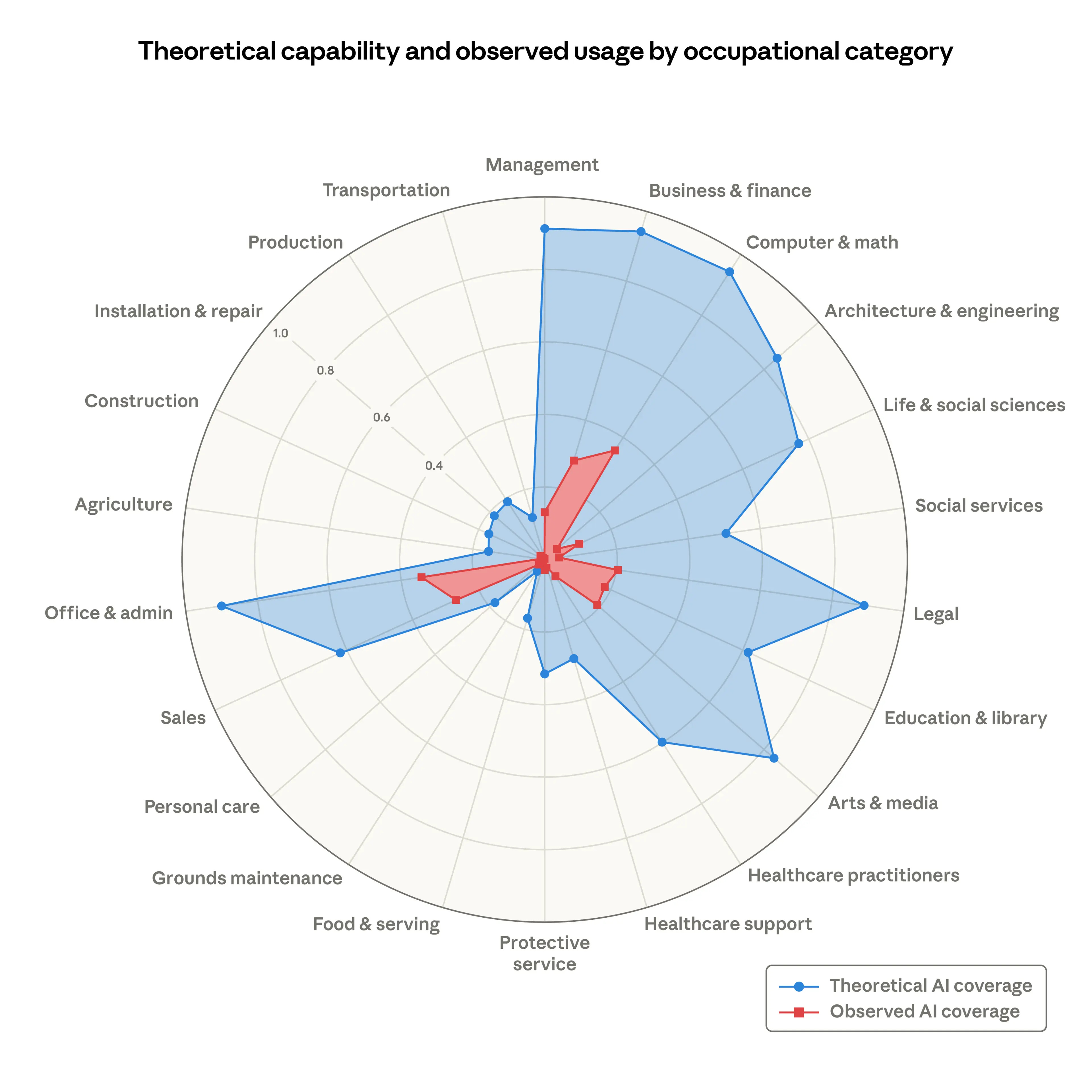
And the answer, at least for now, is not “everything.” Not even close, actually. Even in the most exposed category - computer and math occupations - AI currently covers only about 33% of job tasks. Roughly 30% of workers still have basically zero AI exposure day to day.
That should sound familiar to anyone in legal. The issue in law has never been raw capability. It’s trust. Confidentiality. Knowing whether the first draft is actually good enough to rely on or dangerous enough to create more work than it saves. Lawyers don’t get paid for being fast and wrong.
But here’s the thing. The gap between what AI could do and what it’s actually doing is closing fast. The researchers found a strong correlation between theoretical capability and real usage. So it’s not really a question of whether AI will cover more of those tasks. It’s when. And every new model release makes the “when” feel a lot shorter.
The Young Worker Signal You Shouldn’t Ignore
OK, here’s the part I’d circle in red.
The report found no broad spike in unemployment among AI-exposed workers. That’s the reassuring headline, and it’s real. But dig a little and you see something more specific: hiring of 22-to-25-year-olds into those AI-exposed roles has dropped roughly 14% since ChatGPT launched. Not layoffs. Just slowed hiring. Quieter. Harder to spot if you’re not paying attention.
For most industries that’s a data point worth watching. For law firms it’s a structural warning.
Think about how legal has always worked. Junior attorneys and staff do a huge share of the first-pass work: research, document review, initial drafts, case chronologies. Then they learn by doing. That first-pass stuff isn’t just billable hours. It’s the training ground. It’s how a second-year becomes the kind of fifth-year you’d actually trust with a client relationship.
If firms are already hiring fewer people into those roles (consciously or not) because AI is handling the early-stage production, they’re quietly hollowing out the pipeline that creates senior talent. And that’s not a technology problem. That’s a leadership problem you won’t see coming until it’s too late to fix cheaply.
Where the Pressure Actually Hits
Think about a normal matter. It’s not one job. It’s a stack of smaller tasks. Initial research. First-draft client update. Summarizing a deposition transcript. Pulling key clauses from a contract set. Organizing exhibits. Drafting a motion outline.
Most of that isn’t the final product. It’s the scaffolding around the final product. And that scaffolding is exactly the part most exposed to AI right now.
So the question for firms isn’t “Can AI be a lawyer?” (Still no, in any meaningful professional sense.) The better question is: which parts of legal work can now be done faster, and what does that actually do to your staffing, pricing, and training model?
I see pressure building in three places.
First, the pyramid. If a good associate with the right tools can finish in one hour what used to take four, you need fewer hours at the bottom of the matter. Fine. But you still need great lawyers in five years. You can’t just pull the reps away from junior people and hope development happens on its own. It won’t.
Second, pricing. Clients are getting smarter about this faster than most firms realize. They may not know how every model works, but they understand one thing crystal clear: if the first draft is faster, they don’t want to be billed as if nothing changed. That doesn’t mean race to the bottom. It means you need a better way to explain what clients are actually paying for. Not keystrokes. Not time spent cleaning up routine language. Judgment. Risk assessment. Strategy. Accountability. If you can articulate that, your margins hold. If you can’t, you get squeezed.
Third, quality control. And this is where law really is different from most other professions. Hallucinated cases aren’t a minor bug you patch later. Missed details in a fact pattern can tank a matter. Privilege concerns don’t disappear because the tool is fast. Confidential data pasted into the wrong system can end a client relationship. Courts and regulators still expect a human lawyer standing behind the work product. The firms that win here won’t be the ones throwing AI at everything. They’ll be the ones who know exactly where it helps, where review is mandatory, and where it should stay out of the process entirely.
What To Do Monday Morning
Pick one narrow workflow and map it step by step. Not “litigation.” Something specific, like preparing a first-pass discovery response or drafting an initial case summary. Mark each step as AI-helped, lawyer-reviewed, or lawyer-only. That map will tell you more than any industry report ever could.
Rebuild junior training on purpose. If first drafts and document summaries aren’t the main training ground anymore, decide what will develop judgment instead. Pair associates with partners earlier. Get them in front of clients sooner. Don’t wait for the gap to show up in your bench strength three years from now.
Revisit your pricing story. Be ready to explain what gets faster, what still requires expert judgment, and why that distinction is actually good for the client. The firms with a clear answer keep their margins. The ones who just wave their hands about “value” without specifics will lose that conversation every time.
Set simple guardrails and write them down. What goes into approved tools. What needs human signoff. What stays fully manual. Keep it short enough that every lawyer in the firm actually reads it.
The Bottom Line
Anthropic’s report shouldn’t make lawyers panic. But it should make them pay attention.
The future of legal work probably isn’t a cliff. It’s a slow shift in which tasks get done by humans and which don’t. That shift hits your youngest, least experienced people first. And by the time it’s obvious to everyone, the window to prepare for it has mostly closed.
The firms that see it early will shape it. The ones that don’t will be shaped by it.
You read to the end of a piece about labor market data and junior hiring pipelines, which means you’re not looking for reassurance that AI won’t change your firm. You’re trying to figure out what to do before the bench gets thin and the pricing conversation gets harder.
That’s the conversation I have every day with managing partners and practice leaders working through exactly this. Send me a note at steve@intelligencebyintent.com and tell me where you’re stuck. I’ll be direct about what’s ready to use, what isn’t, and where the gap between the two actually matters for your firm.
One article, every morning, at smithstephen.com. Written for people who run things and don’t have time to separate the signal from the sales pitch. If you’ve read this far, it’s probably your kind of read.