In training sessions this year, the same question kept coming up. Which one do I click, Chat or Cowork? These were smart lawyers, some of them partners running practice groups, and they’d sit with the cursor over the toggle, unsure whether their task was “big enough” for the other mode. I wrote a whole article about the difference recently. As of today it’s out of date.
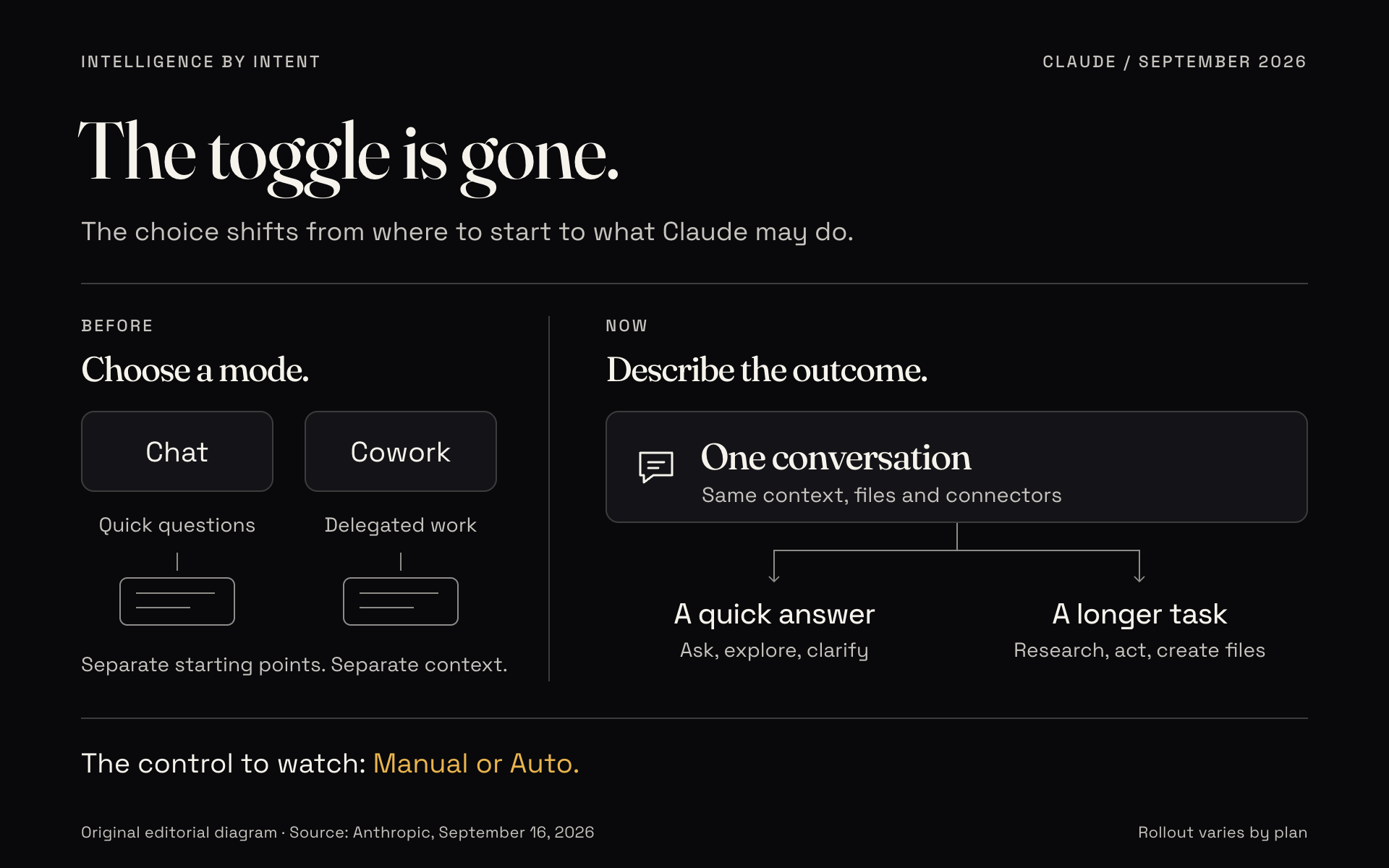
On September 16, Anthropic announced two things. First, Claude Cowork and Claude chat are becoming one product. You type what you want, and Claude works out whether that’s a quick answer or a longer task, and a longer task keeps running after you’ve closed your laptop. Second, Anthropic launched Claude Docs and Claude Slides, both in beta, and moved Claude Design into ordinary conversations. Ask for a memo and you get a living document you and your team can edit. Ask for a deck and you get slides you can present from Claude or download as PowerPoint.
The merge fixes a problem I’ve watched slow people down in training rooms, and the new apps show where Anthropic is going.
The merge, and why it took eight months
Cowork launched on January 12, 2026 as a research preview for Max subscribers on the Mac. The pitch was Claude Code for people who don’t live in a terminal. Over the next eight months it picked up connectors, scheduled tasks, cloud execution, a built-in browser and computer use, and by the time of this week’s merge it ran on web, desktop, mobile and the Chrome side panel.
The problem was the toggle. Anthropic’s own announcement says people “told us the frustrating part was deciding where a task belonged,” and that work started in one mode didn’t carry into the other. That matches what I saw. A lawyer would start a research question in chat, realize she wanted a memo out of it, and have to start over in Cowork. Or she’d open Cowork for a two-line question and burn usage on a full agent run.
Simon Willison, who writes carefully about these tools, admitted he was “increasingly confused at Cowork v.s. Claude v.s. Claude Code.” If he’s lost, your associates have no chance.
So the toggle goes away. Two products remain, Claude and Claude Code. The change is rolling out to Pro and Max accounts over the next few weeks. Team and Free follow “soon.” Enterprise admins get at least 30 days’ notice before anything changes for their organization. Once your account moves over, you can’t switch back.
Two details from the help center matter more than the headline. By default, Claude still asks permission before it takes an action. There’s an “Auto” setting that lets it keep working and only interrupt you when something needs a closer look. And longer agentic tasks that search the web and create files count more against your plan’s usage than a quick question does. The toggle is gone, and a long agent run still costs what it cost yesterday.
Docs and Slides are a bigger deal than the merge
This one made me sit up.
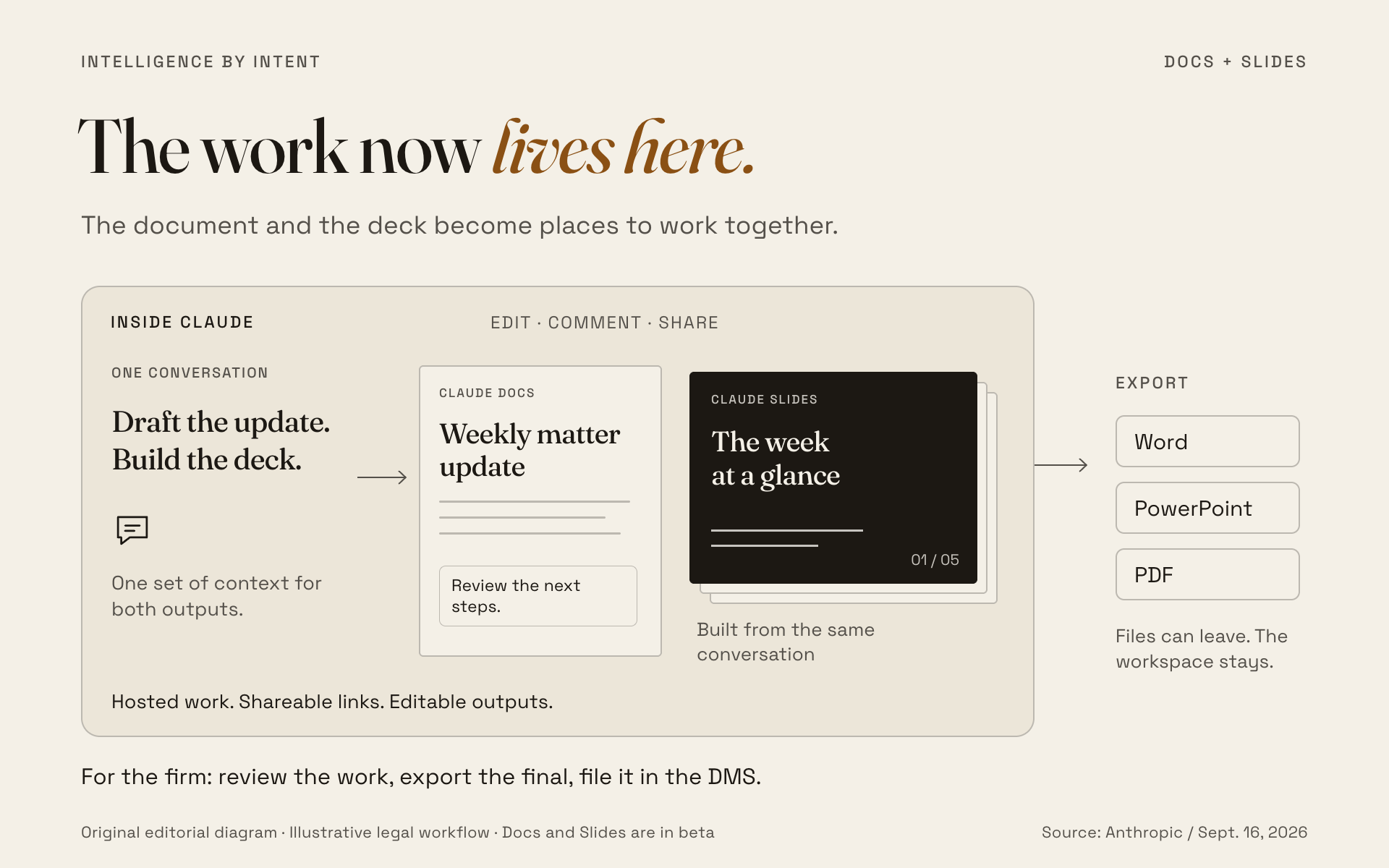
Claude Docs works like a Google Doc that has Claude in it. It drafts sections and leaves comments explaining its choices. Colleagues can edit the same document at the same time. Documents start private, then you share them with named people or your whole organization. Anthropic told VentureBeat they export to Microsoft Word or Google Docs, with more destinations planned.
Claude Slides follows the same idea. Ask for a deck in any conversation, edit individual slides, present straight from Claude, or download as PowerPoint or PDF. Everything lives at one link you can open on your phone.
Anthropic already ships Claude for PowerPoint and Claude for Excel as add-ins that run inside Microsoft’s programs. Docs and Slides are Anthropic’s own document and presentation apps, hosted by Anthropic, with the AI built in from the start. Axios called it “raising the stakes for Microsoft.” I’d put Google Workspace first on that list, since the sharing and commenting model is a near copy of Google Docs.
There’s one obvious gap. No spreadsheet. Claude will build you an .xlsx with working formulas and hand it back as a file, and the Excel add-in exists. But there’s no live, shareable Claude Sheets to sit alongside Docs and Slides. When someone from the Anthropic team that built this took questions on Hacker News, one of the first replies asked whether a Claude Sheets is coming. No answer as I write this. I expect one within the year, and the finance and billing people at your firm will notice its absence before anyone else does.
The strategy is one app
Here’s what a single text box on a paid Claude account now reaches.
Claude can search the web, read your files, run code and produce finished documents. It can open sites, click and fill forms through a built-in browser or through Chrome. On Pro and Max, computer use is in beta, which means it can operate other applications on your screen. The help center’s examples for this launch are Google Drive, Gmail, Microsoft 365 and Slack, and Claude already connects to DocuSign and QuickBooks as well. It runs scheduled tasks in the cloud while your laptop is off. It writes the memo, builds the deck from the same conversation so the two match, and keeps both at a shareable link.
That’s most of what an office suite does, plus a worker who runs it. Anthropic’s own reporting example is a weekly pipeline report that runs itself every Monday and produces a doc plus five slides before you reach your desk. Swap “pipeline” for “matter status” and you can see the version a managing partner would want.
The software companies have reason to be nervous. Cowork’s January launch was one trigger for the software selloff people started calling the SaaSpocalypse, and VentureBeat is careful to note it wasn’t the only cause. But today’s move makes the direction plain. Anthropic wants to be the place where the work happens, with Word and Google Docs reduced to export formats.
What could go wrong, especially at a law firm
I’m in favor of the merge. I also think it creates a few problems a law firm has to handle.
The routing is invisible. Claude now decides whether your request becomes a five-second answer or a long-running agent that uses your connected accounts and creates files. One IT administrator on Hacker News put it plainly. He’d valued having a mode where Claude “was not going to get carried away,” and now he has to rewrite his usage guides after testing how prompts get routed. If your firm has an AI policy that says “use chat, don’t use Cowork,” that policy starts expiring as accounts flip over the next few weeks.
The permission setting is the new control. Manual mode is the default and Claude asks before acting. Auto mode saves time, and it’s where the risk lives. Auto won’t stop to ask before each step, and that includes reads and writes against a connected Drive. Automated safety checks still run in the background, and Anthropic’s help page tells you to stay close for work with real consequences. Keep it on Manual for anything that touches client data until you’ve watched it work.
Enterprise firms get two controls that individual subscribers won’t see. The first is timing. Admins get at least 30 days’ notice before the merged experience reaches their organization. The second is a separate switch for Docs, Slides and Design, which stay off until an admin turns them on. If your attorneys are using their own Pro or Max subscriptions, the merge shows up on their screens in the next few weeks with nobody at the firm in the loop. That gap between plan types is the governance issue I’d fix first.
Where the document lives is a new question. A Claude Doc lives at an Anthropic link, shareable to named people or the whole org. It’s a fine drafting tool. Your document management system stays the file of record. Export to Word and file it where the matter lives.
One more, because I hear a version of it in training rooms. A Hacker News commenter described the nightmare version of Anthropic’s demo. Ask Claude for a deck on the way to work, walk into the meeting, present it cold, and get asked about a detail Claude invented. The commenter’s line was that the shame “instantly kills me.” That problem existed before today. This launch makes it easier to walk into a room with a deck you’ve never read. Nothing about today’s launch changes the rule that you review what goes out under your name.
Two smaller changes. Incognito chats still open in the old experience, so Claude can’t create files or run code there. Older Cowork tasks don’t show up in search yet.
What to do Monday
Find out which of your people are on which plan. The merge reaches personal Pro and Max accounts first, with no admin control. Enterprise gets 30 days’ notice on the merge and a separate switch for Docs, Slides and Design. Decide whether that split is acceptable for your firm, and if it isn’t, move the holdouts onto the firm plan.
Rewrite the one page of your AI policy that mentions Chat versus Cowork. Replace it with a rule about the permission setting. Manual for anything touching client files or connected accounts. Auto only for work you’d let a first-year run without checking in.
Pick one recurring document and try it in Claude Docs. A weekly matter status update is ideal. Let Claude draft it, have two people comment in the doc, export it to Word, and file it in your DMS. You’ll learn more from that one loop than from any demo.
Claude now decides how to do the work. Whether the work is any good is still your call.
Thank you for being a reader. If you enjoyed this, please share it with others.
Magnus is so happy the hot weather is over here in Los Angeles. We’re back to multiple walks a day (versus just two) and as always, he’s making himself at home on the couch whenever and wherever he feels like. ;)