Google Built the Roads. Now It Has to Own the Work.
TL;DR: Google isn’t losing the AI race. It’s sitting on the industry’s strongest asset collection without connecting the pieces. The way back: one Gemini, one developer harness, one company memory, and products only Google can build.
Google doesn’t need another AI comeback. It already has the ingredients. Gemini has 950 million monthly users. AI Mode has passed a billion. Cloud revenue grew 82 percent last quarter, the backlog reached $514 billion, and nearly 90 percent of the Fortune 100 use Gemini Enterprise.
Those aren’t the numbers of a company losing the AI race. They’re the numbers of a company that hasn’t converted its advantages into a coherent position.
Look at the collection: Search, YouTube, Chrome, Maps, Android, Workspace, custom chips, frontier models, a booming cloud, and a growing model of the physical world. Nobody else has that list. Not close. But collections don’t make a strategy. Connections do.
And model leadership may last three months at a time. Gemini 3.1 Pro proved Google can build a frontier model when it wants one. The durable position is the one that keeps getting stronger even when someone else briefly has the smartest model: being the operating system for intelligent work.
Start with one Gemini
The business version of Gemini should be at least as capable as the consumer version. Not eventually. Now. An enterprise customer isn’t buying a reduced Gemini. It’s paying Google to make the real one safe enough for the company’s most valuable information. The difference between consumer and business Gemini should be governance: identity, audit, residency, retention, legal protections. Never subtraction.
Google keeps shipping its best capabilities to consumers first. Spark rolled out to 160 new countries and landed in Chrome while business access sat “in preview.” Flip that sequence with a public parity commitment: every major Gemini feature reaches managed business accounts the same day, with a 30-day maximum when added controls are genuinely required.
Google’s privacy protections are better than most buyers realize, so put them inside the product. Every business surface should carry one plain-English status panel: managed by your organization, your content does not train Google’s public models, retention 30 days, region United States, human review disabled. In the deals I see, that one panel resolves more objections than twenty pages of security PDFs.
Win the terminal
Coding is where enterprises first see measurable AI economics. Complete the task, run the tests, do the math on the hours. It’s also the wedge: the agent that understands your repository today is managing your cloud and your incidents tomorrow.
Google has real momentum here. Antigravity has 2.4 million weekly users, and Google says one internal Chrome team used it to compress a two-year refactoring schedule into three months. Now make it one execution system instead of a family of related products: terminal, IDE, desktop, CI, and Cloud on one architecture, where context and permissions travel with the work and every run leaves an audit trail. Each enterprise run produces a signed manifest: model, tools called, files changed, tests, approvals, cost.
Then give the enterprise version away with meaningful GCP and Workspace commitments, because the standard coding tool decides where a company builds, deploys, and buys compute for the next decade. Google can’t settle for competitive here. It needs to win.
Turn Workspace into the company’s memory
Google’s largest enterprise advantage may not be the model at all. It might be the information already sitting inside Workspace. Gmail knows who talks to whom. Calendar knows what people committed to. Meet holds the conversations, Drive the institutional record.
Connect it into a permission-aware work graph: a federated index, not a giant copy, that preserves whatever permissions already exist on the underlying information. Gemini can then answer what companies actually pay for (what did we decide, who approved it, what’s still open) and act on the answers. A meeting becomes attributed decisions, the follow-up drafts itself, the plan updates, the work gets assigned and tracked, with an audit trail the whole way.
That isn’t another productivity feature. It’s institutional memory. Microsoft can attempt something similar across Office and Teams, but Google holds two extra cards: Search and Chrome.
Make Chrome the action layer
Most of the software enterprises actually run, from legacy systems to niche SaaS to client portals, was never designed for agents. Google owns the browser it all runs through. Managed Spark should become a secure action layer across authorized applications, with admins defining sites, credentials, spending limits, approvals, and evidence retention. Microsoft has Windows and Office. Salesforce and ServiceNow have their systems of record. Google has the browser sitting in front of nearly all of it.
Sell the information products only Google can build
The browser carries Google’s agents into other people’s software. Google’s own data can carry them further, if it’s sold the right way. Every major AI company has models. Only Google has Search, YouTube, Maps, Street View, Earth, the shopping graph, and decades of practice judging which information matters. Don’t pour it all into training. Package selected assets into permissioned commercial products.
Start with a Google Evidence Cloud. Enterprise buyers need reproducibility, not an answer with links attached: the sources, passages, dates, retrieval times, and versions behind every answer. A lawyer shows what was considered. Search becomes an enterprise evidence service.
Then geospatial intelligence. Street View Insights can already analyze physical assets like utility poles across whole regions, so sell it by vertical: insurers, utilities, construction.
And video. Permissioned intelligence on customer-owned and licensed footage, creator rights intact: find the exact moment something happened, check it against the approved procedure, keep the record as evidence.
None of this depends on Google quietly using more data than everyone else. The whole play is packaging: the right data, with permissions, provenance, and commercial terms attached.
Turn the world model into a business
And the most under-priced asset on that list isn’t text at all. It’s Google’s model of the physical world.
Genie generates interactive environments in real time, anchors them to Street View, and already helps Waymo simulate realistic roads. Right now that reads as a spectacular demo. It should be Google Simulation Cloud. An insurer runs a hurricane against a representation of Tampa. An agent practices a task ten thousand times before performing it once. Simulation turns rare, dangerous events into repeatable data.
Simulation leads straight into physical operations. Gemini’s robotics models already reason spatially, plan tasks, watch continuous video, and coordinate machines. Wrap them in a physical agent platform, with identity, safety policies, telemetry, and audit, for robots, drones, and field crews. It’s a category that only exists on top of assets Google happens to own.
Pick a few verticals and go deep
Skip the thirty lightly skinned industry products. Pick the handful where the assets create structural advantage. Cybersecurity is the obvious one: Mandiant, Wiz, threat intelligence, cyber-tuned models, and, per Google, security products already inside 90 percent of the Fortune 100. Then industrial and field operations, where Maps, video, and simulation converge. Health and life sciences on the DeepMind and AlphaFold foundation. Retail and commerce after that.
Professional services stay attractive, and I’ll speak for my own market: a serious legal product needs licensed authoritative content, evidence lineage, matter-level security, and ethical walls, not a general model bolted to web search. Specialization doesn’t mean changing the system prompt. It means building the whole business.
Let customers choose the model
The Agent Platform already offers more than 200 models, including Anthropic’s Claude. Make that central instead of grudging. Gemini for multimodal work, Claude for a coding flow, a small Gemma model on-device. Fine. Google keeps the context, identity, execution environment, security, and compute either way, plus model revenue whenever Gemini wins on merit. Enterprise buyers don’t want a theological debate about model families. They want the best result under the right controls at a predictable cost. Every buyer I advise says some version of that same sentence. Be the company that delivers it.
Sell completed work, not tokens
TPUs give Google a real cost edge, but tokens are an input. Businesses buy outcomes. Price the governed workflow: modernize an application, investigate an incident, review a contract portfolio. “Best intelligence per dollar” is a reasonable model slogan. “Best verified business outcome per dollar” is a much stronger enterprise strategy.
Build one release train
None of this works if every product moves on its own schedule. A model launches when it’s available across consumer, developer, and enterprise surfaces under clear, consistent terms, all the way down to air-gapped Distributed Cloud, not when the research team publishes a post. For governments, banks, hospitals, and law firms, private AI isn’t a niche option. It’s the price of admission.
Then measure like a business: demo-to-production speed, pilots that become operations, cost per workflow, how often humans have to step in. Benchmarks say whether the model is good. These numbers say whether the business is.
Could I be wrong? Sure. Some of this may already be the plan in motion, and betting against Google’s compute has embarrassed smarter people than me. Good. Competition at the top helps every buyer in the market.
Google’s Monday morning
Declare parity day: every consumer Gemini capability reaches managed business accounts the same day or within 30, with the status panel on every surface.
Unify on one developer harness, business first, with signed run manifests, and ship the next flagship only when it wins real production work.
Put a price sheet on the only-Google line this quarter: Evidence Cloud, Simulation Cloud, and one vertical run as its own business.
The twelve-month test
Google doesn’t need to win every benchmark or pry enterprises away from anyone. It needs to make intelligent work go better because Google is underneath it. The test is simple: does a Workspace customer get the good Gemini on day one, does enterprise development run on one harness, and does the world model have a price sheet?
Google already built the roads. Now it has to own the work.
If you enjoy this article, please share it with others.
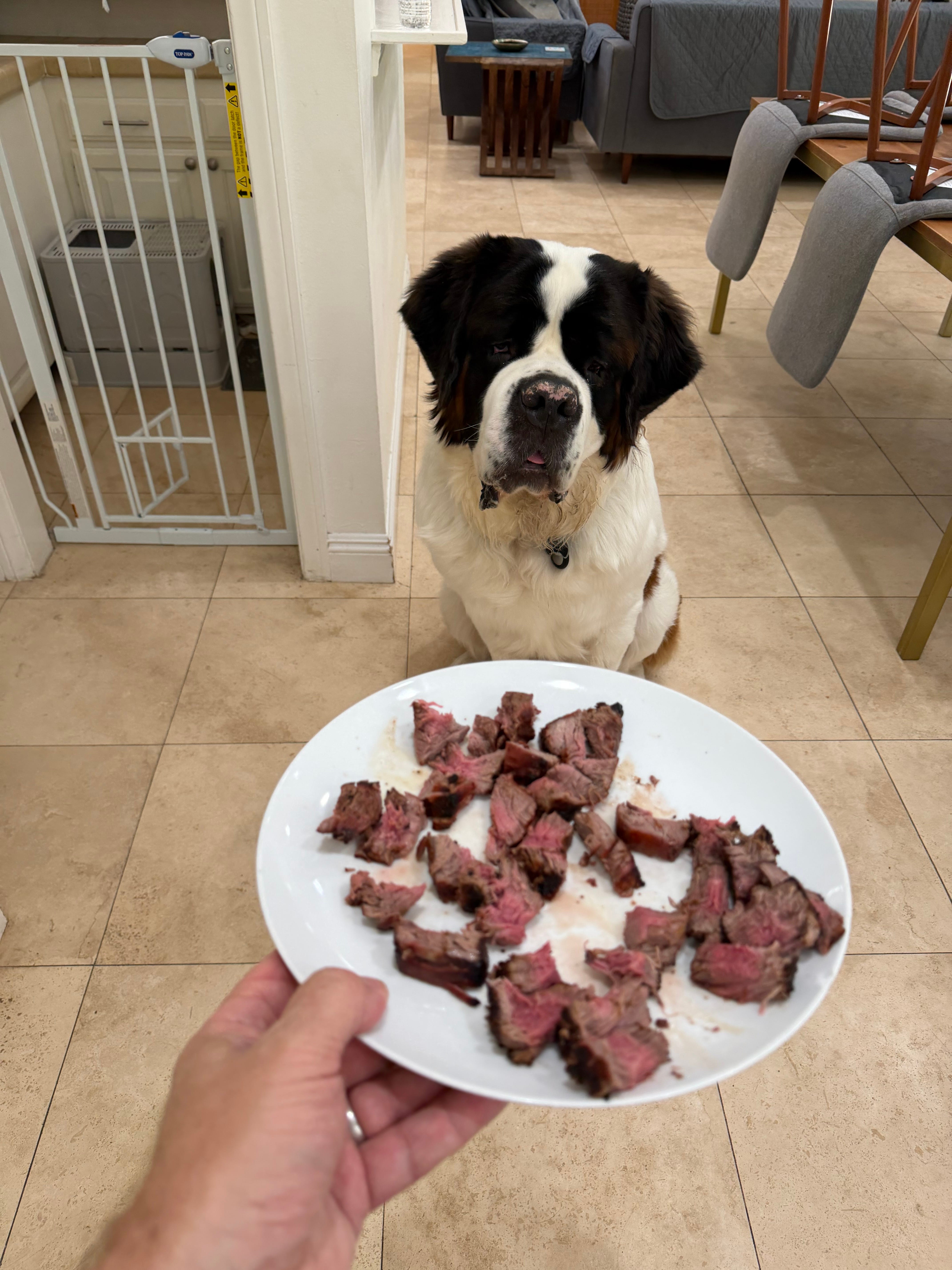
Here’s a shot of Magnus patiently waiting for his favorite food - freshly BBQ’d steak. He knows when I’m cooking it and this is the only time he will patiently sit and watch and wait because he knows what’s coming. Bonus video - he decided to help himself to my wife’s tea. ;)