
TL;DR
After Gemini 3.1 Pro entered preview in February, Google went nearly eight months without a flagship launch. Then it shipped four Gemini 4 models in 36 days, and Neon took first on legal tests at under half rival API prices. Backed by custom chips and a cloud unit that doubled quarterly sales to $30.7 billion, Google put its whole stack on the table.
Back in July, I shared my AI usage split on Substack. Gemini had dropped to 2% of my daily work. Claude and ChatGPT split the other 98%.
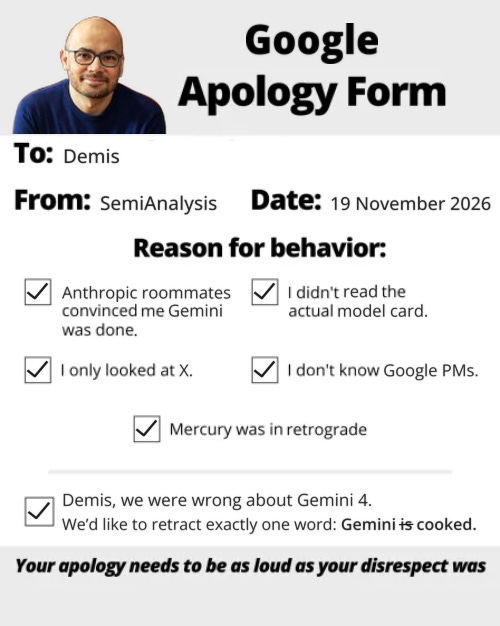
Typing that stung. I train attorneys on AI tools every week and for the last 8 months I could not recommend Google. Last fall I wrote that Google’s vertical integration gave it a formidable moat in AI. Yet for most of 2026, Google looked stuck. Gemini 3.1 Pro entered preview on February 19 and sat there until fall. Gemini 3.5 Pro never arrived. Google shipped cheap Flash updates while business buyers got preview terms with no IP protection and a $25,000 liability cap. Even SemiAnalysis, a site I pay for, ran an August report titled “Gemini is Cooked but GCP is Cooking.”
When Google launched Gemini Enterprise for Legal in late August, I logged back in to my Gemini Enterprise account and asked its “auto” model router for a financial model with working Excel formulas. It apologized three times and handed me loose CSVs. I wrote that a Flash-only schedule wasn’t a frontier plan. Still, in August, I warned myself that betting against Google’s compute has embarrassed smarter people than me.
Over five weeks, Google cashed that check. Starting October 13, DeepMind shipped Argon, Carbon, Hydrogen, and Neon. Put them beside Google’s media and world models, custom chips, cloud unit, and smart glasses, and the picture flips. Google competes up and down the stack.
This piece covers Google's chip and cloud strategy. I also filmed a 15-minute video on my new YouTube channel where I put Gemini 4 Neon and Carbon to work on three messy folders. You'll see them audit an $18.4 million earnout fight with a missing contract waiver, then switch sides to attack our own case. I also run them on an at-risk $420,000 software renewal and a $38.4 million partner program with a hidden cash leak. I've shared every file in the video description so you can try the prompts yourself.
Four Gemini 4 models in 36 days
Google swapped version numbers for elements on purpose. Argon, Carbon, Hydrogen, and Neon sit at distinct points on the speed and cost curve so teams match the model to the job.
Argon ended the drought on October 13 as a stable release and lifted the cap that broke big legal jobs on older Gemini versions. Output used to stop at 65,536 tokens for both thinking and your memo. Argon shares a one-million-token window between your input and its output, and its long-decode mode lets heavy reviews run past the old limit (note that this is only available via the API).
Carbon opened to cyber defenders on October 28 and went generally available November 10 for hard code builds and deep reasoning. On November 12, Hydrogen landed at $1.50 per million input tokens and $7.50 output for fast agent work. On Plotly’s data exam, Hydrogen scored 43 out of 43 for $6.36.
On November 18, Google dropped Gemini 4 Neon. Built off Carbon, it sits between Hydrogen and Carbon, and it was live in Gemini Enterprise and the Gemini API on day one.
Last week, I ran Neon against Claude Fable 5.2 and GPT-6.2 Astra on a five-year pet insurance model and board deck. Neon beat OpenAI on Word and Excel files and finished second behind Claude. On November 19, SemiAnalysis posted a joke apology form addressed to Demis Hassabis.
Neon scores 62 on Artificial Analysis’s general Intelligence Index, three points behind Claude Fable 5.2 and tied with GPT-6.2 Astra. For legal work, it’s out front. Neon took first on the Vals Legal Index at 78.36% and first on the Legal Research Bench at 56.25%. Artificial Analysis’s AA-Omniscience test tracks how models behave when they lack the facts. When Neon didn’t know an answer at high thinking, it made one up 13.9% of the time. GPT-6.2 Astra made one up 59% of the time at its top setting.
Check the price too. Neon costs $3 per million input tokens and $15 output, with cached reads at fifteen cents, against $8 and $40 for Astra and Fable 5.2. Teams get top legal accuracy at under half the API price of Google’s main rivals.
Right now Gemini 4 Neon is the model I reach for the most. I will note though that I use it in Antigravity or T3 where I can take advantage of its full power (not the Gemini web interface or Gemini app). Even though Claude Fable 5.2 beat it in my tests in the past week, Fable is far slower, costs significantly more and you have much more limited usage. When you look at price and performance together Neon absolutely dominates.
Video, audio, world models, and math that proves itself
Most leaders judge AI vendors by their chat box. That misses half of what Hassabis and DeepMind built in London and Mountain View. Veo 3.1 makes 4K-upscaled video with built-in speech and sound effects, and Lyria 3.5 creates three-minute songs and vocals.
Genie 4, the world model now rolling out to Ultra subscribers, builds playable worlds live, with sound that matches the scene. Waymo already tests its cars in a simulator built on Genie 3, and DeepMind pitches Genie 4 as a practice space for robots.
Google also leads in deterministic models that prove their work. Standard language models guess the next word, so lawyers still check every cite. DeepMind pairs generative AI with verifiers that refuse to guess. AlphaProof checks math proofs in formal logic until an answer is proven right. AlphaFold 3 maps molecules for drug discovery, and AlphaEvolve pairs Gemini with code checkers to invent faster algorithms.
That points toward recursive self-improvement, or RSI, where AI speeds up building the next AI. In September, I read the source papers to separate RSI hype from fact. Runaway self-improvement isn’t here today. Still, AlphaEvolve and AlphaChip already lay out new processors and tune the code that trains upcoming Gemini models. If Google hasn’t hit early RSI yet, it is at the door.
No Nvidia tax and a $30.7 billion cloud quarter
Put your CFO hat on. Hardware decides price wars. Most labs still wait in Nvidia’s line and pay Nvidia’s fat margins. Even Anthropic rents Google’s TPUs, by the gigawatt.
Google has built Tensor Processing Units for over ten years, up through seventh-generation Ironwood pods. Owning the silicon helps Google price Neon at $3 and $15.
Alphabet’s Q3 2026 report from October 28 shows the payoff. A year ago, Google Cloud grew 34%. Last quarter, Cloud sales doubled year over year to $30.7 billion, up 103%. Cloud operating profit more than tripled to $11.1 billion at a 36.2% margin, and backlog hit $560.8 billion. Direct TPU sales to outside labs now add serious revenue too.
Power subscriptions and glasses on your face
Google AI Ultra runs $99.99 and $199.99 a month. Alongside huge Gemini and video limits, it packs in fast Colab GPUs and $40 to $100 a month in Cloud credits. On the $199.99 tier, that’s half your bill back, and Google can afford it because it owns the cloud. The credits work on the Gemini API and Google’s Agent Platform, the old Vertex AI, so you can prototype in AI Studio, the test kitchen where an app comes together in an afternoon. Ultra also gives you more Antigravity, where Carbon can plan code jobs and hand the grunt work to cheap Hydrogen workers. The Colab credits are great as I can use them to render ultra high quality video versus having to pay additional fees to services like Higgsfield or Runpod.
OpenAI and Anthropic meet you in a browser tab or someone else’s phone OS. Google owns Search, Chrome, Android, Workspace, and YouTube. Pre-orders opened November 12 for Android XR glasses from Warby Parker and Gentle Monster, built on Samsung hardware. They ship December 10, and Warby Parker’s frames start at $395. They put a camera and open-ear audio with live Gemini help on your face.
Where Google can still trip
My CFO instincts kick in fast on Alphabet’s cash flow statement. Alphabet spent $51.4 billion on capital gear in Q3 alone, up 114% from a year earlier. Free cash flow fell to negative $9.1 billion, its second straight negative quarter. Spending roughly $200 billion a year on data centers and chips leaves thin cushion if corporate AI budgets cool off, and rising depreciation will squeeze margins. Still, $560.8 billion in contracted backlog and 36.2% Cloud margins show corporate buyers are already signing checks.
Account sprawl still trips up compliance teams too. Personal Gemini accounts, Pro and Ultra included, now keep chats for about two months even with history turned off, so client or patient files never belong there. Neon’s base knowledge stops at March 2026, and it burns a lot of thinking tokens at top effort. Claude Fable 5.2 still wins on warm prose and slide design.
Even with that cash burn and menu clutter, I wouldn’t bet against Google over the next five years.
What to do Monday morning
Test Gemini 4 Neon in a paid Gemini Enterprise or Agent Platform account on one messy job that ends in a Word memo or Excel file, and compare edit time and cost against your current default.
Keep personal Google AI Ultra plans for public-data builds in AI Studio and Colab, and hold client or company files in your managed business account.
Pause before signing a multi-year deal on any $1,000-per-seat AI wrapper until you check whether Neon and Google’s Agent Platform cover that job for a fraction of the bill.
For eight months, smart operators counted Google out. Look at the custom chips, the $30.7 billion cloud quarter, the DeepMind lab, and Gemini 4 Neon leading legal tests at half the market price, and it’s clear who holds the strongest hand in AI right now.
Thanks for being a reader. I hope you enjoyed this article and the YouTube video. Please share this with others and subscribe if you are not a subscriber (it’s free!). For those of you in the US, I wish you a very Happy Thanksgiving! Magnus and I are getting ready for a feast tomorrow and enjoying the colder weather here in Los Angeles.