

Google’s 2025 AI comeback: why they’re now the company to beat
A year ago, if you asked me who was winning AI in the real world, I’d have said OpenAI first, Anthropic second, Google third.
Not because Google didn’t have the talent. They always did.
It was because the products didn’t land as daily habits. Too many impressive demos. Too few “this is how my team works now” moments.
December 2025 feels different. Loudly different.
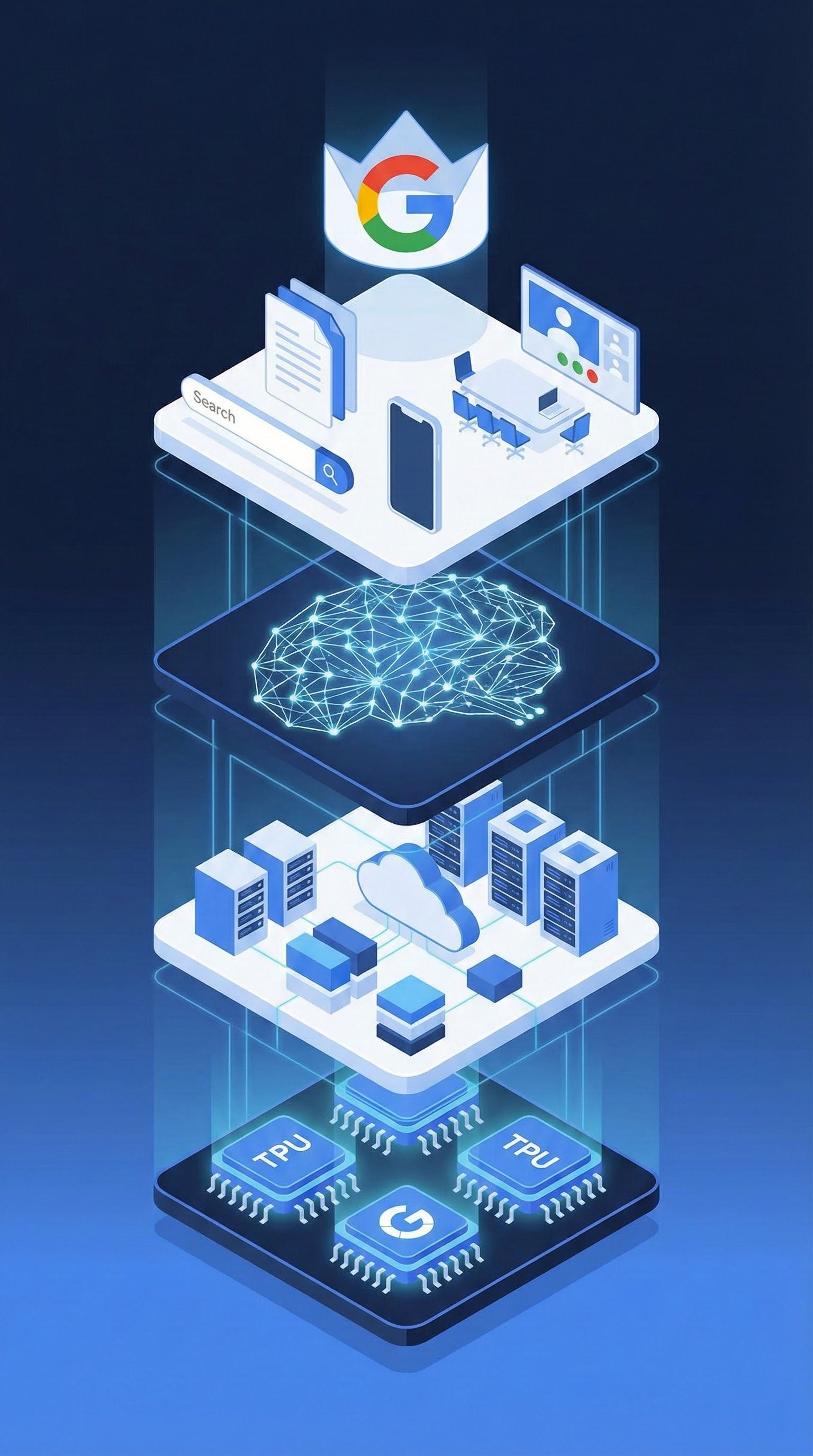
This year, Google didn’t just ship a better model. They shipped an entire stack, end to end, at a pace that changed the conversation. Models that are strong and priced to run everywhere. Search that’s becoming an AI interface. Tools that turn video, images, and docs into outputs people can actually use. And the infrastructure underneath it all, from TPUs to distribution, that makes the whole thing compound.
From my seat, Google went from “catching up” to “setting the pace.”
What changed this year
There were plenty of individual launches. But the real story is that Google started shipping like a company that believes AI is the core product.
Three shifts drove it.
First, they stopped treating models like isolated releases and started treating them like a product line with clear roles. Fast models for high-volume work. Stronger models for hard reasoning and coding. Image and video models that are not side experiments, but part of the same family and surfacing across the same places.
Second, they pushed distribution into the center of the strategy. Gemini isn’t just “an app.” It’s showing up in Search, Workspace, Android, and Pixel. That matters because adoption is not won in a benchmark chart. It’s won in default behaviors.
Third, they made cost a headline feature. That sounds boring, but it’s the unlock. A model can be brilliant and still fail inside companies because it’s too expensive to run at scale, too slow, or too hard to integrate. Google leaned into the opposite: capability plus price plus surfaces.
That combination is why 2025 felt like “worst to first.”
Models: the big leap wasn’t only intelligence, it was practicality
Let me simplify the model story the way an operator needs it.
Google spent 2025 building a lineup where you can match the model to the job without changing the whole approach.
You have fast, cheaper variants meant for “AI everywhere” work: support, summarization, extraction, classification, routing, and the 1,000 small tasks that make teams more productive.
You have stronger models aimed at complex reasoning, coding, and longer context problems.
And you have multimodal models that treat text, images, audio, and video as first-class, not bolt-ons.
The part I’ve been watching closely is the trade between quality and cost.
In a lot of companies, the best model is not the model you can run. The best model is the one you can afford to deploy broadly, with predictable latency and predictable spend. Google’s pricing posture in late 2025, especially with Gemini 3 Flash, is a statement: “we want you to build on this at scale.” That’s a different posture than “pay for the premium model and hope the ROI shows up.”
This is also where I think the “Pareto frontier” point is real. If you translate that into plain English, it means: the best mix of quality and cost. That’s where adoption tends to follow.
Search: AI Mode turned distribution into a weapon
Search is still one of the most underappreciated advantages in AI.
Not because chatbots aren’t valuable. They are.
But because Google owns a default behavior: when people want an answer, they search.
AI Mode takes that behavior and nudges it toward an AI-native experience. Longer questions. Follow-ups. A back-and-forth that feels more like a conversation than a link list. And then Google keeps the one thing that matters for trust and action: it still connects to the web.
From a business lens, this changes two things fast.
It changes discovery. If customers increasingly get answers inside AI-driven Search experiences, your content strategy, your product pages, your reputation, and your authority signals become even more important. You’re not only ranking for blue links. You’re competing to be the source that the AI trusts and cites.
And it changes internal expectations. Once executives and employees get used to “I ask, I get a synthesized answer,” they bring that expectation into every tool. That accelerates demand for AI inside your own systems.
This is why I keep coming back to distribution. Google didn’t just make a strong model. They placed it where billions of people already are.
Media generation: video and images went from novelty to usable outputs
A lot of “gen media” has looked fun but not usable.
The gap is almost always the same: the output isn’t consistent, text inside images is messy, or you can’t control the result well enough to use it in real marketing, training, or product work.
In 2025, Google made media feel more like a product capability than a party trick.
On video, Veo moved into developer access and started to look like something teams can build workflows around, not just make one-off clips.
On images, Imagen improved, and then the “Nano Banana” line became the headline. The reason it caught fire is simple: it’s aimed at the exact places business users get stuck.
Editing an existing image without ruining it.
Keeping a character or subject consistent across a series.
Combining multiple images into one coherent result.
And most importantly: getting text inside the image to look right.
Nano Banana Pro, tied into the Gemini 3 family, is Google signaling that image generation is not a standalone app. It’s part of the stack, and it’s going to show up in the places work actually happens, like Slides, ads workflows, and content creation tools.
If you’re running a marketing team, this is where the “time-to-first-draft” changes. Not the final output. The first draft. And that’s a huge shift in throughput.
NotebookLM: the quiet killer app for knowledge work
If you asked me to pick the single Google AI product that most consistently turns skeptics into believers, it’s NotebookLM.
Because it’s not trying to be a general chatbot. It’s trying to be your research assistant for the materials you already trust.
This year, NotebookLM kept adding features that make it feel like a real work surface: better ways to map what’s in your sources, better ways to generate outputs in different formats, and richer “overview” modes that turn a pile of documents into something you can brief to a team.
The key point is grounded work. A lot of organizations are fine using AI if they can answer one question: “Show me where this came from.” NotebookLM’s core design aligns with that instinct.
In practice, it becomes a force multiplier for exec prep, deal work, case prep, board materials, and internal research. I’ve seen it save hours in a way that feels obvious once you use it.
Workspace: Gemini stopped being a feature and started being part of the day
The AI story inside productivity tools tends to be won with small wins.
Not the “wow” moments. The daily friction removals.
In 2025, Gemini moved deeper into Google’s productivity tools, including mobile. That matters because “AI at your desk” is one thing. “AI where work happens” is another. If your team lives in docs, email, and meetings, the best AI is the one that shows up there without a new workflow and without a new login.
This is also where Google’s advantage becomes hard for competitors to match: the assistant, the documents, the meetings, and the identity layer all live under the same roof.
That doesn’t guarantee success. But it makes the path shorter.
Devices: Pixel made Gemini feel ambient
The future of assistants is not “open an app and type.”
It’s “help me while I’m doing something.”
Pixel leaned into that hard this year. Live camera and voice. On-screen awareness. The sense that Gemini is watching the context you’re in and can respond in real time.
Whether you buy a Pixel 10 (I did!) or not, the direction is the point: Google is pushing Gemini toward being an always-available layer across the phone, not just a destination you visit.
This matters because phones are the most personal computing surface we have. If your assistant lives there by default, it wins attention. And attention is the scarce resource.
Developer tools: agents got closer to real work
I’m allergic to the word “agent” when it’s just marketing.
But 2025 was the year it started to feel practical, especially in software work.
Google pushed into coding assistants and agentic tools through multiple surfaces. You see it in products like Jules. You see it in new development environments like Antigravity. And you see it in the push toward “computer use,” where the model isn’t only answering questions, it’s interacting with interfaces.
The best way to think about this is simple: the model is moving from “advisor” to “doer.”
That shift changes everything about how teams build internal tools and how vendors build product features. It also introduces risk, which I’ll come back to.
Infrastructure: the TPU advantage is showing up in the product experience
This is the part most people skip because it sounds technical. But it’s the reason I’m taking Google seriously as a long-term winner.
When you control the chips, you can drive down cost. When you drive down cost, you can ship AI everywhere. When you ship AI everywhere, you collect feedback and usage at a scale others can’t match. And then you get better faster.
TPUs are not new. What’s new is how directly they are now tied to go-to-market. Google is acting like they want TPUs to be a default inference platform in the cloud, not a niche advantage. And they’re working to reduce the practical barriers developers face when moving workloads.
This is where the “full stack” argument becomes real. Chips. Cloud. Models. Consumer distribution. Enterprise distribution. Same company, aligned incentives.
There are very few companies on earth that can put that together.
The betas and gated releases: where the signal is hiding
One reason Google felt like it launched 200 things this year is because they’re shipping in multiple lanes at once.
Some releases are broad. Others are previews. Others are Labs experiments or limited to certain plans, regions, or early access groups.
That’s not a problem. It’s how you ship fast without breaking everything.
But if you’re writing an end-of-year view, you need to be honest about what’s still gated:
Some Gemini 3 capabilities are still in preview, and the highest-end “deep think” options roll out to smaller groups first.
Some Search AI Mode features depend on where you are and what language you use.
Some media generation access is tiered or limited, especially in the early phases.
Google Labs experiments like “cc” are exactly that: experiments. High signal, but not a promise.
The right takeaway is not “Google is everywhere.” The right takeaway is “Google has many shots on goal, and they’re promoting winners into the core stack quickly.”
That’s what the best product organizations do.
What this changes for business leaders
If I had to boil it down:
Google made AI feel less like a tool and more like a default layer across how people search, create, collaborate, and build.
That matters now because 2026 is going to be a year of adoption sorting. Teams that keep AI as a side activity will get stuck in pilot mode. Teams that bake it into the operating rhythm will compound.
And Google is positioned to benefit from that compounding because they can ship AI into the places work already happens, at prices that make broad rollout possible.
Risks and tradeoffs I wouldn’t ignore
Even if you buy my “Google is now #1” take, there are real risks to manage.
Quality drift is one. Fast models are great until they’re wrong in subtle ways.
Governance is another. When AI is embedded in docs, email, meetings, and Search, the question becomes: what data is being touched, where it’s stored, and what controls you actually have.
And then there’s agent risk. The moment models can take actions, you need guardrails, approvals, and monitoring. Otherwise, your assistant becomes your new source of operational incidents.
The good news is that these are solvable problems. But they’re not optional problems.
What to do next
Run a real bake-off on your work
Pick 3 to 5 workflows that matter and test Gemini against your current tools using your own inputs, quality criteria, and compliance needs.Treat AI Mode as a go-to-market change
Audit how your company shows up in AI-driven search experiences and adjust content, product pages, and authority signals accordingly.Standardize on one “work surface” for internal knowledge
If you’re drowning in docs, pilots, and scattered notes, pick a grounded workflow (NotebookLM is a strong candidate) and make it the default for research and briefing.Build a cost model before you scale
Don’t roll out AI broadly without a unit cost view. Model usage, caching, peak loads, and guardrails so you don’t get surprised.Put guardrails in place for action-taking tools
If you test agents or “computer use,” start with approvals, sandboxing, and audit trails. Make safety a design requirement, not a policy document.
The bottom line
Google didn’t win 2025 because they shipped one great thing.
They won because they shipped a coherent stack, pushed it into the world’s biggest distribution channels, and made it affordable to run at scale.
That’s how you go from “third place” to “company to beat.”
And heading into 2026, I’m planning like Google is the new pace-setter.
I write these pieces for one reason. Most leaders do not need another breakdown of Google versus OpenAI versus Anthropic; they need someone who will sit next to them, look at where AI actually touches their business, and say, “Here is where Google’s stack now makes sense for you, here is where another tool might still be the better fit, and here is how we keep all of it governed, predictable, and worth the investment.”
If you want help sorting that out for your company, reply to this or email me at steve@intelligencebyintent.com. Tell me what workflows are dragging, which tools your team already uses, and where you’re stuck between pilots and real adoption. I will tell you what I would test first, which part of the stack I would put on it, and whether it even makes sense for us to do anything beyond that first experiment.