
Google shipped the right strategy today. Then it couldn’t make me a spreadsheet.
TL;DR: Google Cloud launched Gemini Enterprise for Legal and for Financial Services, both in preview. The vertical packaging is the right call and the partner list is real. The trouble sits underneath. The enterprise router picks models that can’t finish the job, and the flagship Pro model has sat in preview since February, which under Google’s own terms means no SLA, no indemnity, no support, and no PHI. Open the file before you sign anything.
Thomas Kurian published a sentence this morning I’ve spent two years trying to get managing partners to say out loud. “Foundational model intelligence is necessary. For legal work, it is nowhere near sufficient.”
He’s right, and the whole post is right. Most serious models are good enough now. What decides whether a firm gets value is everything built around the model. Skills that carry your playbook, connectors into the matter itself, agents that finish work instead of suggesting it, and governance that lets risk management say yes.
Then I opened Gemini Enterprise and asked it to build me a spreadsheet.
Google made the best public argument I’ve read this year that the model is not the product. An hour later its own product proved the point, running the other way.
What Google actually shipped
Two industry solutions, announced together, both in preview. Legal debuts with Cleary Gottlieb, Freshfields, Weil, and Williams & Connolly as launch customers. Google built Financial Services with Deutsche Bank and CME Group as design partners. Healthcare and life sciences are next. Hold that thought.
The partner list is the part I’d read first. On the legal side Gemini connects into iManage and NetDocuments with document-level permissions and ethical walls intact, into Everlaw and RelativityOne for litigation evidence, into Docusign for contract obligations, and into CourtListener for dockets. Harvey and Legora are both in there, which is Google conceding that specialist legal AI keeps its own seat. Deloitte and Eudia ship agents on day one. Finance gets FactSet for market data, Moody’s for counterparty risk, PitchBook for private markets and SEC Edgar for filings. All of it feeds a Google-built research agent that carries more than fifty skills and cites its sources.
I’ve argued for a while that the next advantage comes from redesigning how work moves through a firm. This launch is that argument with a price tag on it. It’s also not sold where most professionals work. Gemini Enterprise is a separate Google Cloud platform starting around $21 per seat, and $30 if you need the compliance controls. If your firm runs Workspace, none of this reaches you.
The spreadsheet that never came
I was in Gemini Enterprise with Auto selected, the setting that lets Google pick the model for you. I asked for a multi-year income statement, cash flow statement and balance sheet for a made-up B2B SaaS company, with an assumptions page, formulas tying throughout, a charts tab and a dashboard up front. Standard CFO homework, as an Excel file with a download link.
It went off, told me it was calling agents, worked for a while, and announced it was done. No link.
So I asked where the file was. It apologized, blamed a missing software library, and promised a coding agent would fix it. Nothing happened. When I asked again it named a library as the problem: xlsxwriter (not sure how that really helps me). Then it offered me CSVs instead.
I asked then to create this in Google Sheets. Couldn’t do that either. I got a pile of CSVs and instructions to import each one by hand. So much for formulas that tie.
So I opened a fresh session in my Gemini Enterprise and selected Gemini 3.7 Flash, which I know builds Excel files because I’ve watched it work great in Antigravity. It built one. I downloaded it and it had a circular reference. Oops. High thinking would have fixed that. And Enterprise gives you no way to turn the reasoning effort up, so I couldn’t give it more room.
Gemini 3.7 Flash can build a workbook. Gemini Enterprise on Auto couldn’t get me one. That gap is the whole product.
Here’s the cheapest test in AI procurement. Run the artifact your work actually ends in, three times, on every model you’re licensed for. Not a question. A file. Then open the file.
One failure isn’t a verdict. Models miss, and a formula-linked workbook is about the hardest thing you can ask for. The failure that counts is different. The router picked a model that couldn’t do the job, the system told me it was done when it wasn’t, and nothing in the interface let me overrule the choice.
The strongest objection here is a good one, so give it its weight. Gemini Enterprise for Legal isn’t a spreadsheet tool. It’s a governed retrieval and agent platform, and by that measure permissioned access into iManage and Everlaw is exactly what firms have been asking for since 2023. The model picker is a Vertex concern. Different problem, different team.
Fair. And it still lands on the same router.
Skills and connectors don’t run themselves. They run on a model selection you can’t see or override, and their output lands in a file that goes to a client. Governance you can audit, sitting on a selection you can’t, is a thinner promise than it looks.
Three pickers, one brand
Open the model menu in consumer Gemini, Workspace, and Enterprise on the same day and you get three different answers.
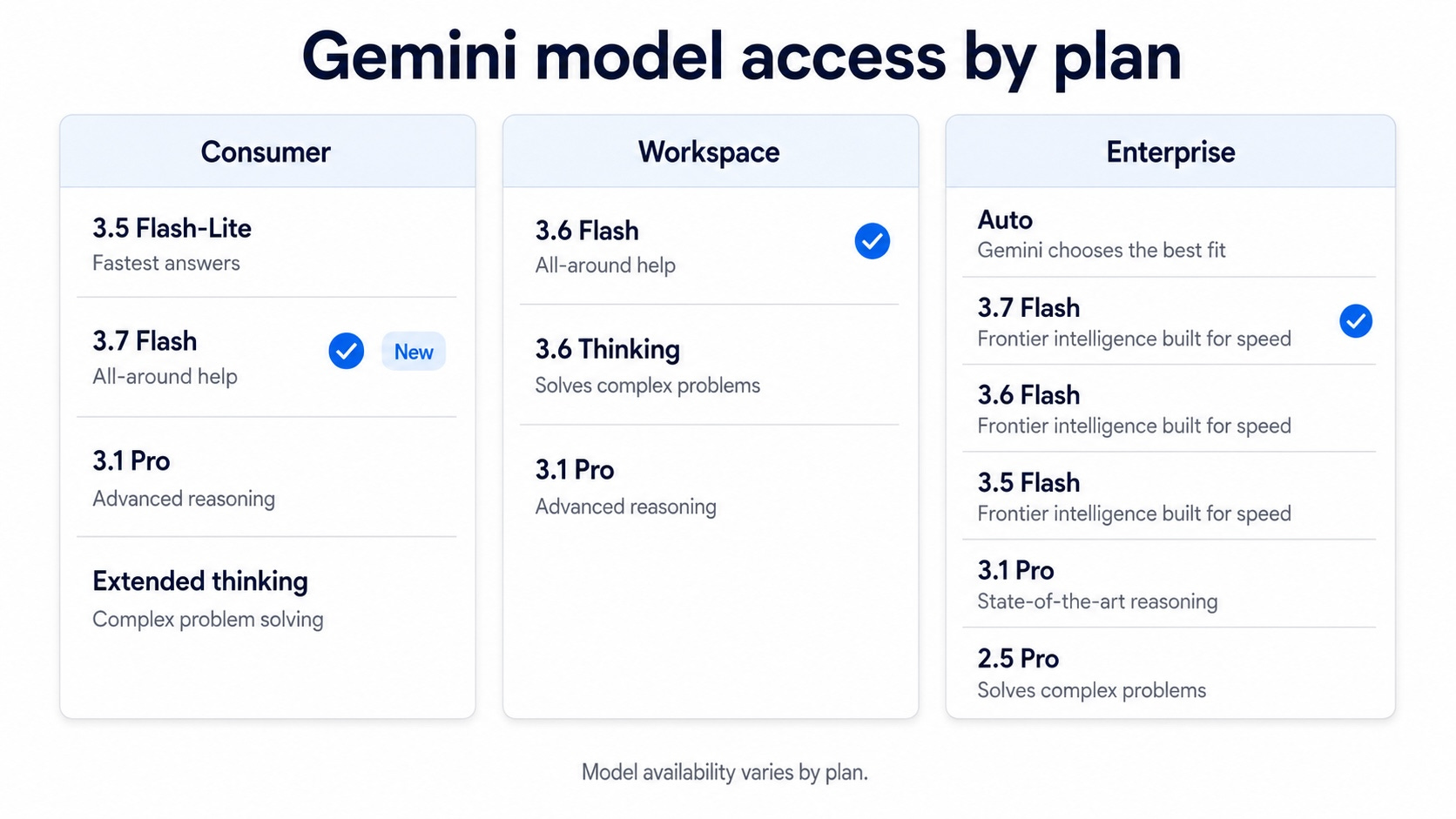
Consumer has 3.7 Flash, flagged as new, plus 3.5 Flash-Lite, 3.1 Pro, and a toggle for extended thinking. Workspace tops out at 3.6 Flash and a thinking variant. Enterprise lists six models, three of them Flash releases with word-for-word identical descriptions, and no thinking control at all. Consumers get the newest models and the most control over how hard the model works. Enterprise buyers, paying the most and carrying the most risk, get the least.
Gemini 2.5 Pro, from 2025, is still on the enterprise menu. My read is that it’s there because it’s the only Pro model that’s generally available. Gemini 3.1 Pro went to preview on February 19 and Google said general availability would follow soon. Today is August 25. That’s six months of soon. Gemini 3.5 Pro never arrived at all. Google announced it at I/O in May targeting June, and CNBC reported in July that it fell short internally on coding.
Meanwhile the Flash line ships almost monthly, and 3.7 Flash costs $0.75 per million input tokens against $2.00 for 3.1 Pro. That $0.75 is an introductory rate through December 31, and it doubles after that. Even at the doubled rate you’re paying a premium for an older generation because it wears the Pro badge.
The fine print on preview
Preview isn’t a maturity label. It’s a set of contract terms, and Google publishes them.
Read the Pre-GA Offerings Terms in Google Cloud’s Service Specific Terms. Here’s what you’ve signed. There’s no SLA and no Google indemnity, which is the IP indemnity your general counsel asks about first. Technical support doesn’t cover it by default. The data location commitments don’t apply, which bites if you have residency obligations. Google can change, suspend or discontinue the model at any time without notice, and it caps its own liability for a preview offering at $25,000.
Then there’s the part I checked twice. Gemini Enterprise is on Google’s covered products list, so the platform itself is fine. The exclusion lands one layer down. The Service Specific Terms define a Pre-GA Offering to include models labeled Preview, and the HIPAA page tells customers not to use pre-GA offerings with protected health information. The preview notice on 3.1 Pro does allow production use and personal data under the data processing addendum, but personal data under that addendum is not PHI under a BAA. So if you hold a signed BAA, the platform is covered and Google’s most capable reasoning model still isn’t. Not discouraged. Excluded.
Now hold that against the roadmap. Google announced today that healthcare and life sciences verticals are coming. Its flagship reasoning model has been off limits for PHI since February.
Don’t assume that’s somebody else’s problem. Med mal defense, ERISA and health plan work, health system outside counsel. Plenty of firms touch PHI, and Gemini Enterprise for Legal is in preview too.
There’s one more worry buried in the timing. Google confirmed in July that it’s training Gemini 4 and called it its most ambitious pre-training run yet. Pichai told analysts days later that the next frontier needs a much larger base model. I believe them, and I think Gemini 4 fixes the frontier problem. It also means Google replaces the model layer under everything it announced today. Firms piloting a preview product on a preview model, with a new generation inbound, are not piloting what they’ll run. I wouldn’t sign a twelve-month commitment in front of that.
Here’s a call you can grade me on. Google ships its healthcare vertical before 3.1 Pro reaches general availability. Check back in January.
What I’d tell a managing partner
Kurian wrote that model intelligence is necessary and not sufficient. That’s the thesis of my whole practice, and Google published it better than I have. The gap is that the sentence applies to Google too.
Three moves. Run the artifact test this week on whatever stack you’re evaluating, including this one, and count how many times you got a working file instead of an apology. Get it in writing which model executes which task, whether you can pin it, and whether that model is GA, because Auto is a routing decision someone in your firm should own. And if you’re under a BAA, fence the preview models off today rather than waiting for the vertical to ship.
I love these models. I still can’t recommend the stack.
Google wrote that line. Google should read it back.
Thank you for reading. If you enjoyed this, please consider reposting and sharing with others.
Magnus is super food motivated. Here is is patiently waiting for a string cheese from my son. Hopefully this heat will break in Los Angeles soon so we can go on longer outdoor walks again.