


Six Percent: The AI Hallucination Number That Surprised a Room of Family Lawyers
TL;DR: I asked a room of family law attorneys to guess how many of the world’s tracked AI hallucination cases involve family law. Their guesses ran from 20 to 90 percent. The real number is 6. The more useful finding is who’s behind those cases, and what it tells you about where the risk is heading.
Bring up AI hallucinations in a room full of lawyers and you can feel the air change. People sit up. A few arms cross. Everyone has read the headlines by now: the sanctions, the lawyer who filed a brief built on cases that never existed.
I was at the AAML National Family Law Conference in Las Vegas this week, giving the AI keynote, and hallucinations came up. They always do. A few weeks back I was on a panel with the LA County Bar Association, and there it was again. It’s the question that won’t sit down.
So in the keynote, I tried something. I asked the room to guess what share of the tracked hallucination cases worldwide involved family law. Hands went up. Twenty percent. Fifty. Someone said ninety.
The real number is six.
Three things worth saying out loud
Early in the talk I put up a slide with three things I think are worth saying before anyone gets comfortable. Here’s the first, and it’s not the controversial one: the risk is real. Mata v. Avianca was not the last sanction, not even close. Real attorneys are still filing briefs full of cases that don’t exist, and they’re paying for it with real money and real public discipline.
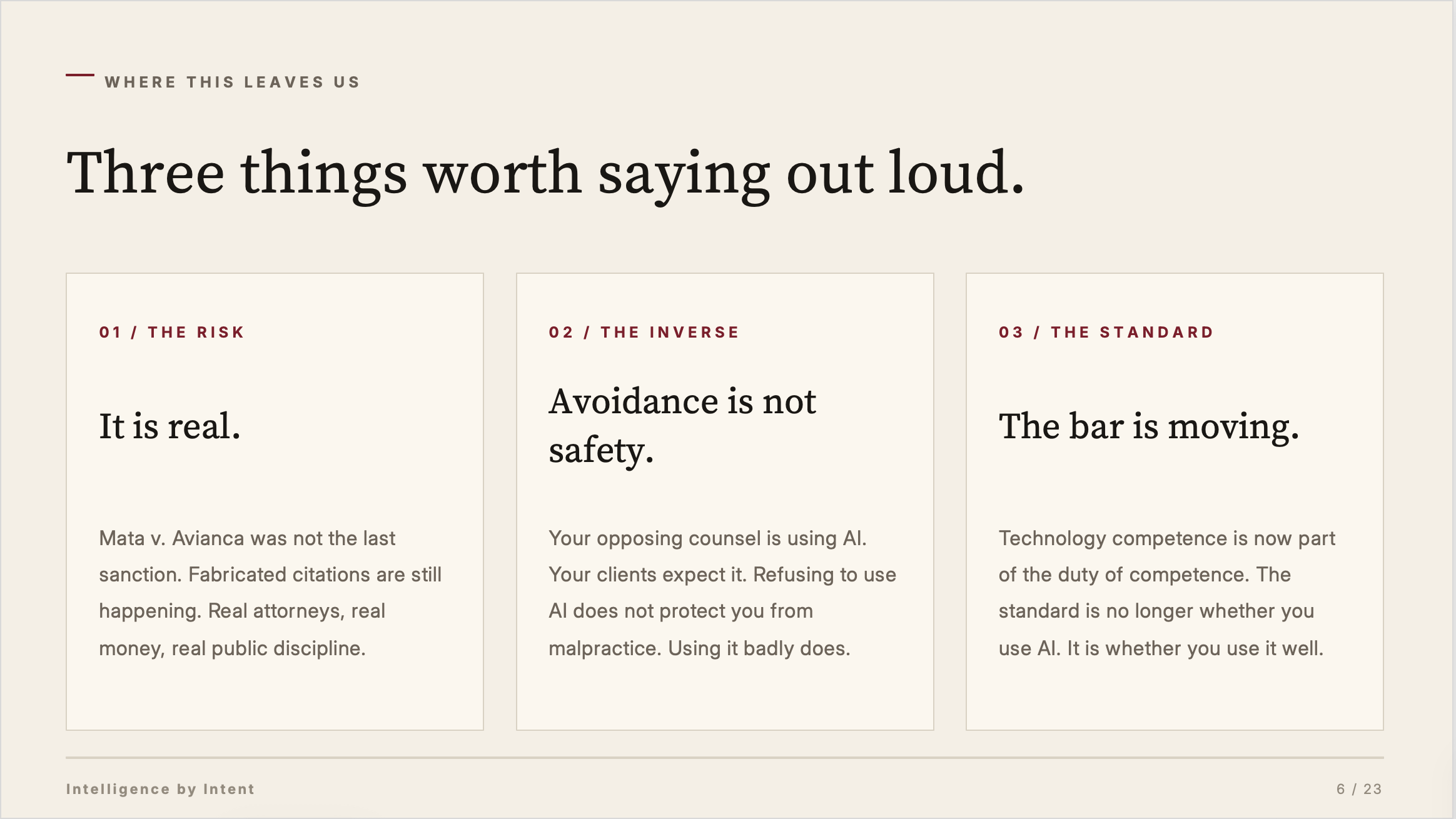
The second is the one that makes people shift in their seats. Avoidance is not safety. I watch this one land differently than people expect. Your opposing counsel is already using these tools. Your clients assume you are too. Refusing to touch AI doesn’t shield you from a malpractice claim. Using it badly is what gets you there. That reframe does more work than any horror story about a sanctioned lawyer.
And then the quiet one underneath both. The bar is moving. Technology competence is part of the duty of competence now, and the question stopped being whether you use AI. It’s whether you use it well.
Where the number comes from
None of this is a hunch. There’s a research fellow at HEC Paris, Damien Charlotin, who has been tracking these cases globally, and doing the best job of it I’ve seen. He keeps a running database of them. The charts are worth an hour of your time. And the part I appreciate most is that he doesn’t paywall any of it. The whole dataset is free to download, so I did. I encourage you to go explore his site!
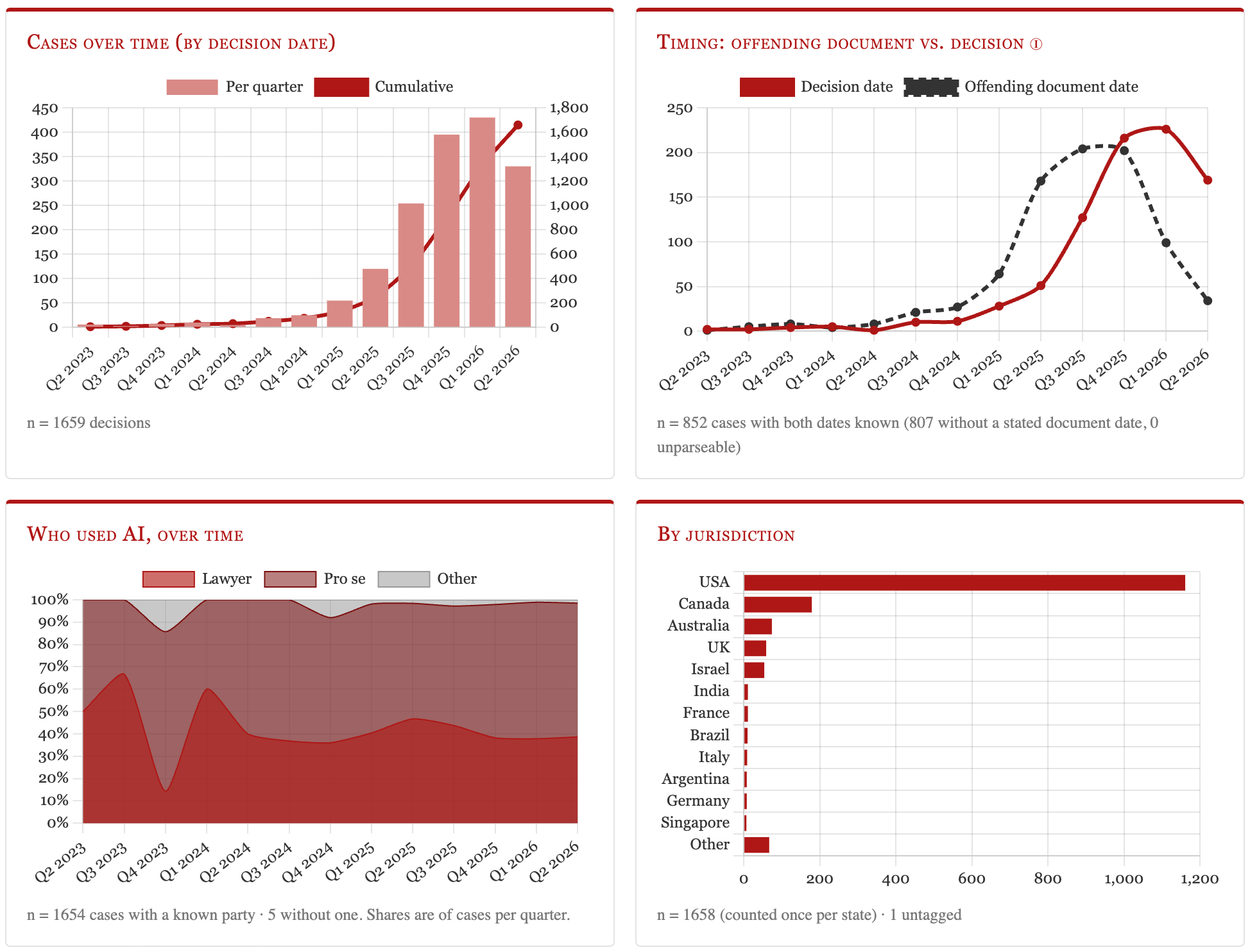
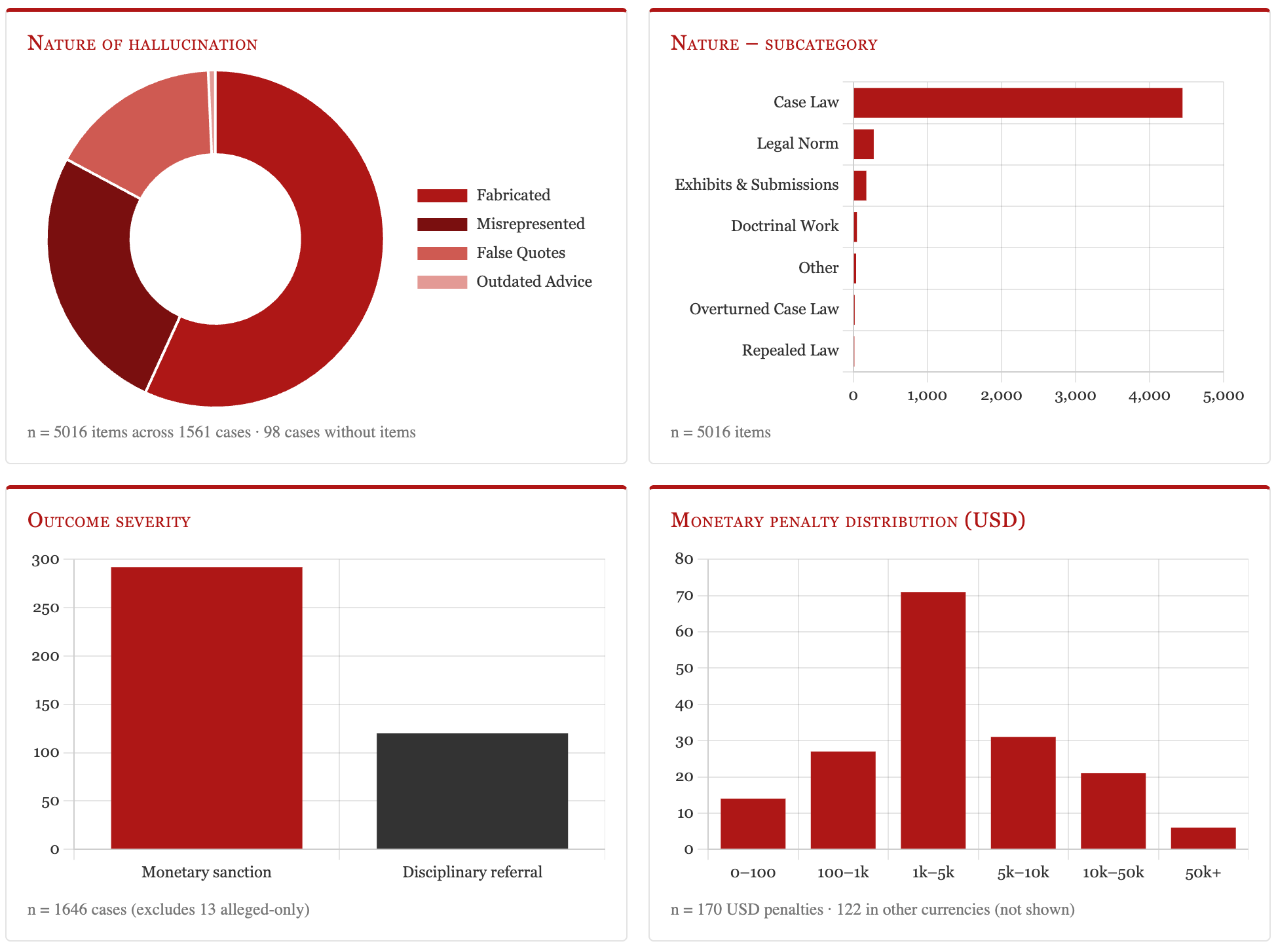
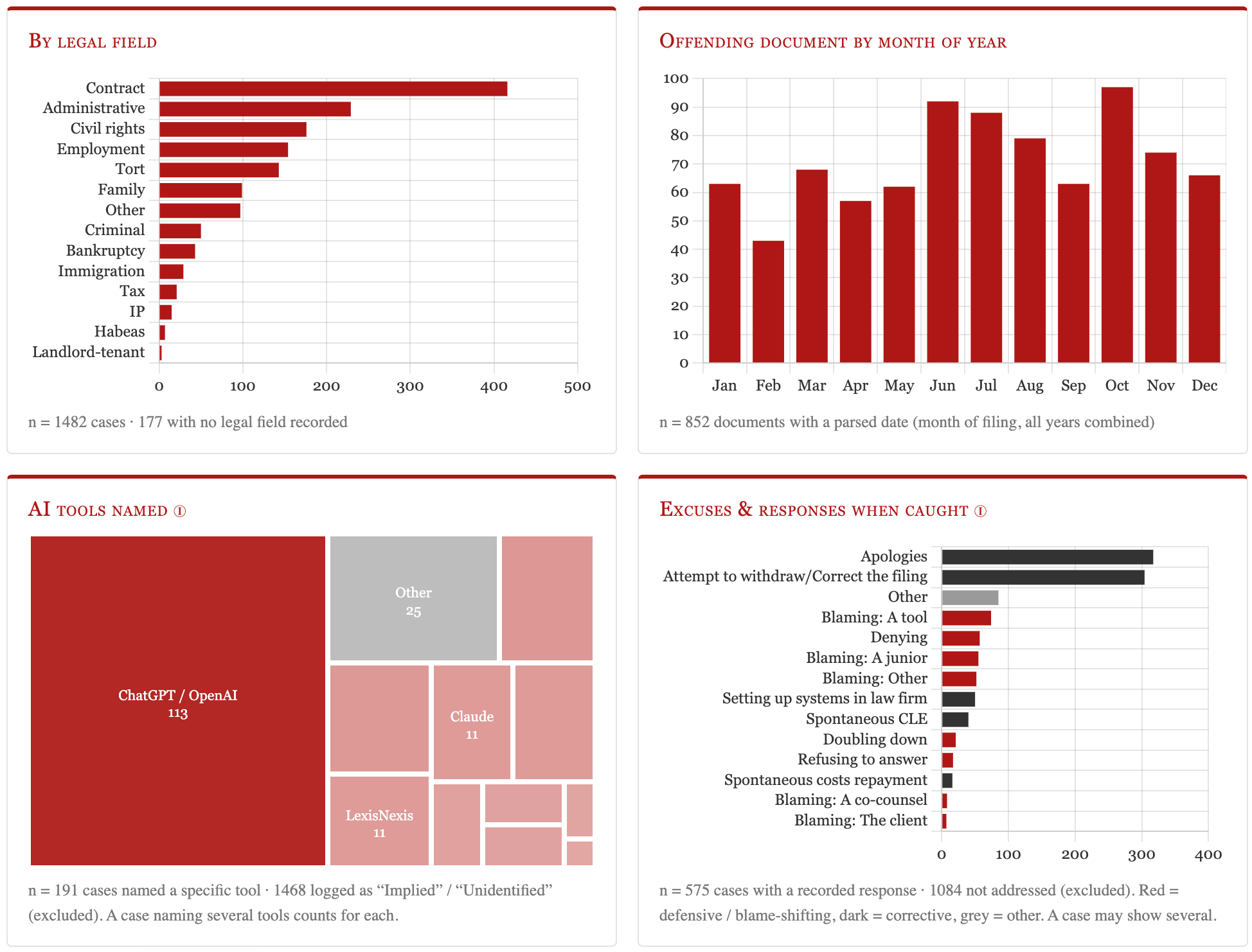
As of this week, he’s tracking 1,659 decisions. The curve is steep. Two years ago you’d see a handful of these a quarter. Lately it’s a few hundred. Most of the fabrications are case law: confident citations to opinions that were never written. And in the minority of cases that name a tool, one comes up far more than any other. ChatGPT. Not because it’s worse than the rest, but because it’s the one people reach for. A general-purpose assistant, doing a job that really needs a legal research database.
Who’s getting caught
Here’s where it got interesting for the family law crowd. Of those 1,659 cases, 99 are family law. That’s the six percent. But I wanted to know who was behind them, so I split the 99 by who filed the bad document.
Sixty-eight of them, 69 percent, came from people representing themselves. Not lawyers. Self-represented litigants.
That tracks once you think about who those people are. Someone handling their own custody case reaches for what’s free and in front of them: a search engine, a consumer chatbot. They don’t have Westlaw or Lexis. And they have no way to look at a clean, confident citation and sense that the case behind it doesn’t exist. An attorney builds that instinct over years, reading enough opinions to feel when something’s off. A parent fighting for custody on their own has no reason to have built it.
The harder problem is coming for the courts
And that’s the part that isn’t really about lawyers at all. If self-represented litigants are the main source of these fabrications, and the tools keep getting easier to use, the volume of confident, fake-citation-laden filings landing on court dockets is going to climb. Judges and clerks are the ones who’ll absorb it. I don’t have a clean answer for how the courts handle that. I just know it’s coming, and faster than most of the system is ready for.
If you’re a family law attorney, six percent should be a relief. It mostly isn’t you. But don’t let it turn into comfort. The number is low today. It’s also climbing across every field, and the bar for competent use keeps rising whether or not your practice has caught a sanction yet. Low risk is not the same as no risk. And it’s a long way from no responsibility.
What I’d do Monday
If you take three things back to your firm, make it these.
Match the tool to the task. A general-purpose assistant is great for a first draft, a summary, a way to think out loud. It is not a citation engine. When you need case law, use a database built for it. Most of the fabrications in the data come from using the wrong tool for the job.
Put a human on every output, and make the check a real one. Not a skim. Someone opens each cited case and confirms the holding says what the brief claims it says. That last part matters more than people think. A meaningful share of these cases aren’t invented cases at all. They’re real cases bent into saying something they never said, and a fabricated cite and a misread one fail the same way in front of a judge. Put it in writing as a policy, not a good intention.
Build a real final pass. A fact-checking step, a skill, a checklist, something that catches a fabricated cite before it reaches a judge. It backs up the human review. It does not replace it.
Here’s the thing the headlines keep missing. These tools are getting better fast. They draft, they summarize, they can read through tens of thousands of documents before you’ve finished your coffee. That’s real, and it’s worth using. But none of it touches the part that matters. Clients aren’t paying you to produce text. They’re paying for your judgment. Your read on the case. The thing you catch that the model never will.
That part isn’t going anywhere. It’s the reason someone hires you instead of asking the chatbot themselves.