


created by ChatGPT Image 1.5
2026 Is the Year AI Separates Winners from Everyone Else
TL;DR: AI capabilities are accelerating faster than most leaders expected. Models will get smarter, hallucinate less, and run for hours autonomously. Knowledge workers will see their jobs fundamentally change. For law firms and professional services, this creates an urgent choice: adapt now or watch competitors pull away permanently.
You know that feeling when you finally figure out a new tool, and then they release the next version?
Get used to it. Because 2026 is shaping up to be the year when AI moves from “interesting experiment” to “how we actually work now.” And the gap between those who’ve been paying attention and those who haven’t? It’s about to become a chasm.
I’ve been thinking a lot about what this year will bring. Not the model releases or the lab drama. The stuff that actually matters to you running a business, a practice, a team. Here’s where I’ve landed.
AI Progress Will Accelerate Even More This Year
The AI you’re using today will look quaint by December.
I’m not being dramatic. The models are getting smarter at a pace that keeps surprising even the people building them. But here’s what matters more than raw intelligence: they’re getting reliable. They hallucinate less. They’re dramatically better at using tools. And they can run autonomously for much, much longer.
A year ago, coding agents could reliably handle tasks that took humans about 5 minutes. Today, the best models handle tasks that take nearly 5 hours. If that trend holds, we’re looking at models that can reliably complete 20-hour projects by end of year.
Think about what that means. An AI that can take on half a week’s worth of focused work, autonomously.
That word “reliably” is the key. The difference between a tool that works 60% of the time and one that works 95% of the time isn’t 35 percentage points. It’s the difference between a toy and something you can actually depend on.
Coding Will Continue to Dominate, and the Tools Will Get Scary Good
If you’ve been watching the AI space, you’ve noticed that coding is where the action is. That’s not changing. If anything, it’s accelerating.
The tools are running longer. They’re calling sub-agents to handle specialized tasks. They’re debugging their own work. What used to require constant hand-holding now runs in the background while you do other things.
But here’s what I think people miss: this isn’t just about professional developers. The same capabilities that let engineers build faster are going to let everyone else build things they never could before. Designers building functional apps. Lawyers automating their own workflows. Finance people creating custom analysis tools.
The barrier between “having an idea” and “having a working tool” is collapsing. That changes everything about who can create what.
Knowledge Work Changes Substantially
Here’s where things get uncomfortable.
The organizations winning with AI aren’t bolting new tools onto old workflows. They’re redesigning processes from scratch. This isn’t a technology problem. It’s a process problem.
Consider what this looks like in practice. At Toyota, teams built agents that pull data across their entire pre-manufacturing to delivery workflow, automatically flag delays, and draft resolution emails before anyone even arrives in the morning. The work didn’t disappear. It transformed.
Now think about your weekly standup. Your quarterly business review. Your end-of-year planning. All of those assume humans are gathering information, synthesizing it, and presenting it. What happens when AI can pull together data from Slack conversations, documents, dashboards, and email threads, then surface the insights before the meeting starts?
The meeting becomes about decisions, not updates. The prep work vanishes. The synthesis happens automatically.
Analysts have long estimated that roughly a quarter of lawyers' work activities are automatable with today's tech. And legal sits among the functions most exposed to AI-driven task automation. But here's the thing nobody talks about: the firms reporting massive productivity gains aren't laying people off. The jobs are changing. The people doing them need to change too.
The 10x Productivity Gains Are Real, But There’s a Catch
I keep hearing about people getting 10x more productive. And honestly? I believe it. I’ve seen it in my own work.
But there’s an asterisk large enough to drive a truck through: you have to completely rethink how work gets done.
This isn’t about automating existing processes. It’s about asking whether those processes should exist at all. Henry Ford said it back in 1922: “Many people are busy trying to find better ways of doing things that should not have to be done at all.”
The people seeing 10x gains aren’t the ones using AI to write slightly faster emails. They’re the ones asking entirely different questions. Instead of “how do I draft this contract faster?” they’re asking “why do we draft contracts this way at all?”
If you’re trying to get AI to help you do your current job slightly better, you’re thinking too small. The real gains come from reimagining the work itself.
We’ll Connect Data Like Never Before
Right now, most company data sits in silos. Your CRM knows one thing. Your project management tool knows another. Your financial systems hold yet another piece. Getting these systems to talk to each other requires expensive custom work.
That’s changing fast.
The next wave of AI doesn’t wait for you to ask questions. It observes what you’re doing and intervenes proactively. Your IDE suggests the refactor before you ask. Your CRM drafts the follow-up email when you finish a call. The chat interface was training wheels. Now AI becomes invisible scaffolding woven through every workflow.
For law firms, think about what happens when an AI can pull information from document management systems, billing records, client files, and communications simultaneously. The research that used to take hours happens in minutes. The connections you’d never make manually become obvious.
Thomson Reuters is launching agentic workflows featuring autonomous document review. LexisNexis now deploys multiple specialized agents working together on research tasks. Contract management systems are promising 50% reductions in review time.
But here’s the catch. These tools only work when they can access your data. Organizations that have spent years creating data architecture problems now face a choice: fix the foundation or watch competitors gain access to capabilities you can’t match.
This Is the Year People and Companies Get Left Behind
Here’s the prediction that should keep you up at night.
The advantages from AI compound. Someone who learned to use these tools effectively in 2024 didn’t just save time that year. They developed intuitions and workflows that made them faster in 2025. And those 2025 advantages are accelerating into 2026.
Meanwhile, the people and organizations who waited are now trying to climb a steeper hill.
I see the data on this, and it’s stark. Only about 11% of organizations are actively using agentic AI systems in production. Over 40% are still just developing their strategy. More than a third have no formal strategy at all.
Those percentages tell a story about the separation that’s coming.
In-house legal departments are pulling ahead of outside counsel. Over 60% of corporate legal teams expect to rely less on outside counsel going forward. Law firms without demonstrable AI capabilities face a structural disadvantage.
The honest truth is that catching up becomes harder every month. The compound effects work against you. This isn’t a wave you can wait out. It’s a current that’s moving whether you swim or not.
What This Means for Your Business
Every industry faces its own version of this pressure, but the patterns are consistent.
Your cost structure is about to get stress-tested. Competitors who figure out AI-native workflows will operate with fundamentally different economics. Tasks that take your team hours will take theirs minutes. That gap shows up in pricing, in margins, in how fast they can move.
Your talent strategy needs rethinking. The future looks like junior employees who are AI-savvy feeding insights to senior professionals who excel at strategy and judgment. Middle layers of work that used to require experienced humans? Increasingly handled by agents. If you’re hiring the same way you did two years ago, you’re building a workforce for a world that’s disappearing.
Your client relationships will shift. The companies and firms that understand AI well enough to use it internally will be the ones clients trust to advise them on it. If you can’t demonstrate fluency in your own operations, why would anyone believe you can help them with theirs?
And your competitive moat may be thinner than you think. The advantages that used to take years to build, deep expertise, proprietary processes, accumulated knowledge, those can now be replicated faster than ever. The new moat is speed of adaptation. How quickly can you absorb new capabilities and put them to work?
What to Do Monday Morning
If you’re running a team or a firm, here’s where to focus:
Start with one end-to-end process. Don’t sprinkle AI across everything. Pick a workflow where you can genuinely redesign, not just accelerate. Ask whether the process should exist in its current form at all.
Get your data house in order. Nearly half of organizations cite data searchability and reusability as barriers to AI automation. If your documents, emails, and case files can’t be accessed by AI systems, capabilities that competitors are using remain unavailable to you.
Assign someone the autonomy to experiment. You need leadership alignment, active experimentation, and broad adoption. Someone needs real authority to try things, fail, and iterate.
Prepare for workforce changes. The future looks like junior employees who are AI-savvy feeding insights to senior professionals who excel at strategy. Start thinking about what that means for your people.
Pick one person to stay radically current. The pace of change means institutional knowledge about AI becomes stale within months. Someone needs dedicated time to track developments and translate implications for your practice.
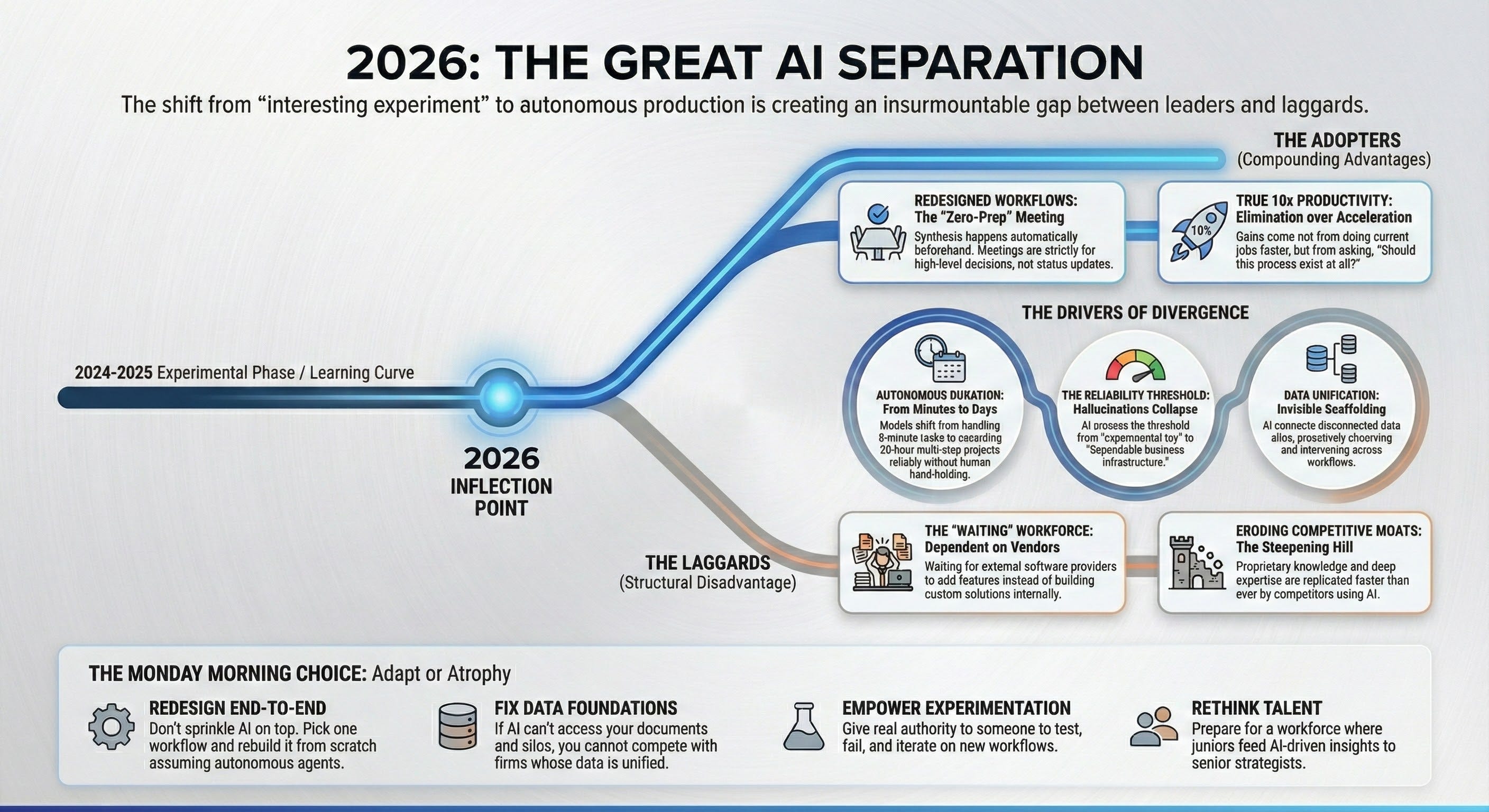
created by Nano Banana Pro
The Choice Is Yours
Look, I’m not trying to scare you. But I’m also not going to pretend this is a drill.
2026 is a decisive year. Models will get meaningfully more capable. Adoption will separate into leaders and laggards. The compound advantages for early movers will become more difficult to overcome.
For law firms and professional services, the stakes are particularly high. Your clients are facing these same pressures. They need advisors who understand AI well enough to help them navigate it. And increasingly, they’ll choose partners whose own operations demonstrate that understanding.
The tools are here. The question is whether you use them.
And that’s a question only you can answer.
Why I write these articles:
I write these pieces because senior leaders don’t need another AI tool ranking. They need someone who can look at how work actually moves through their organization and say: here’s where AI belongs, here’s where your team and current tools should still lead, and here’s how to keep all of it safe and compliant.
In this article, we looked at why the “wait and see” approach to AI adoption has become the riskier bet, and how compound advantages are separating leaders from laggards faster than most executives realize. The market is noisy, but the path forward is usually simpler than the hype suggests.
If you want help sorting this out:
Reply to this or email me at steve@intelligencebyintent.com. Tell me what’s slowing your team down and where work is getting stuck. I’ll tell you what I’d test first, which part of the agentic AI stack fits your workflows, and whether it makes sense for us to go further than that first conversation.
Not ready to talk yet?
Subscribe to my daily newsletter at smithstephen.com. I publish short, practical takes on AI for business leaders who need signal, not noise.