

How I Actually Keep Up with AI (And How You Can Too Without Losing Your Mind)
You’ve asked me this question more than any other this year: “How do you keep up with all the AI news?”
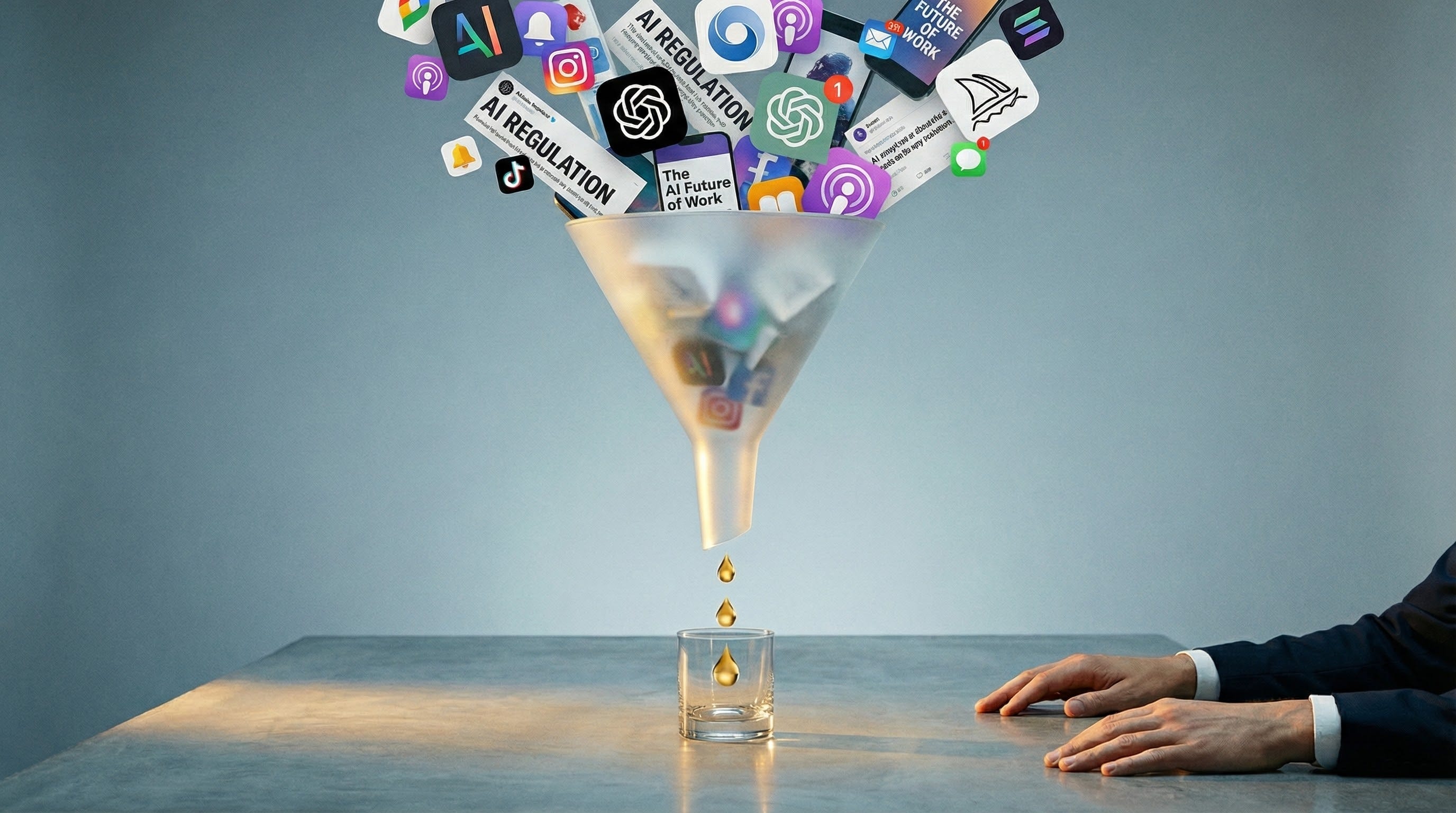
Here’s the honest answer: I don’t. Not all of it. Nobody can. The trick isn’t consuming more. It’s building a system that surfaces what actually matters for business decisions and filters out the noise.
So instead of just dumping a list of subscriptions on you (if you really want it - email me and I’ll send it to you), I want to share the framework I use. Because the goal isn’t to read everything. The goal is to know enough to make good decisions for your organization without AI becoming a second job.
My Daily Non-Negotiables
Every single day, three sources get my attention: the AI Daily Brief podcast (I actually subscribe on Patreon), Stratechery podcast, and Nate B. Jones (YouTube). No exceptions. These are the foundation of my AI information diet. I listen while taking a shower, walking the dog, getting my wife her morning coffee, whenever I have dead time. By mid-morning, I have a clear picture of what moved in AI overnight and why it matters.
If Matthew Berman drops a new YouTube video on any given day, I watch it. His hands-on demos show you how new models and tools actually perform, not just what the press release claims. When everyone was hyping a new release last month, Matt’s video showed it struggling with basic tasks. That kind of honest testing saves you from chasing shiny objects.
And here’s one that surprises people: I read The Information every single day. Every article. It’s expensive, yes. But they break stories about what’s happening inside companies that matter months before anyone else reports it. If you need to understand the business dynamics driving this industry, there’s nothing better.
What I Read Throughout the Week
Ben’s Bites lands in my inbox weekly, and I read every issue. It’s a great curated roundup of AI news, tools, and launches. Quick to scan, and I consistently find useful things I would have missed otherwise.
One Useful Thing from Ethan Mollick is a must-read whenever he publishes an update. He’s a Wharton professor (I got my MBA at Wharton), and he’s actually studying how AI changes work. His posts are research-backed and practical, not hype.
Simon Willison’s blog is more technical, but when he writes about a new capability, I pay attention. He’s one of the most credible voices on what AI can actually do versus what’s marketing.
Semi Analysis covers chips and AI infrastructure. I check it a couple of times a week. If you want to understand why NVIDIA matters or what’s happening with custom silicon, this is your source.
Every (every.to) and Nate’s newsletter (natesnewsletter.substack.com) round out my paid subscriptions. Both focus on practical AI adoption for knowledge workers and enterprises. Every has some of the best writing on the internet on AI. Full stop.
Where I Get Breaking News
I won’t sugarcoat it: X (formerly Twitter) remains the fastest source for AI announcements. I follow maybe 200 people in the AI space, and when something big drops, I know within minutes. LinkedIn and Reddit have AI communities, but I find almost nothing useful there. If you want my X follow list, email me, and I’ll send an export.
The Tools I Actually Use (And How)
I subscribe to more AI tools than any reasonable person should. But I do it so you don’t have to. Here’s what I’ve learned about where each one shines.
Gemini 3.0 Pro has become my daily driver. The combination of that massive context window, the speed, strong reasoning, and tight integration with Google’s ecosystem makes it incredibly versatile. For general-purpose AI work, it’s my go-to.
Claude Max handles my reasoning and writing work. When I need to think through a complex problem or draft something that needs to sound human, Claude is where I go. The writing quality is noticeably better, and the reasoning on nuanced questions is excellent.
ChatGPT Pro is my choice for financial analysis when accuracy matters. When I’m digging into numbers, building models, or doing research that requires real precision, ChatGPT’s strengths show up. Different tools for different jobs.
Perplexity, I’ll be honest about. I’m a long-time subscriber, but I almost never use it. Occasional one-off searches, that’s about it.
For building things, my preference order is clear: Claude Code first, then AntiGravity, then Droid, and Lovable for the occasional quick front-end. Claude Code has become remarkably capable at coding tasks. Droid’s scaffolding and flexibility are excellent when I need more control. I’m still exploring AntiGravity from Google, but I love where it’s going. I occasionally use Eleven Labs for voice work.
The tool I use most might surprise you: Wispr Flow. I use it probably 50 times a day. Not exaggerating. It’s a voice dictation tool that has transformed how I get content into any system: email, documents, notes, prompts, coding. I just talk, and it captures everything accurately. If you do any amount of writing or content creation, this one tool will change your workflow more than anything else on this list.
A couple other smaller tools: Granola for meeting notes, TypingMind as a unified interface for multiple AI models (one-time purchase, highly recommend), and NotebookLM Enterprise for client work when I need to synthesize large document sets with the highest levels of security and privacy.
One tool I want to truly make a special call out on: NotebookLM from Google. I think this is the single most impactful tool for most people that was released this year. Its ability to consume hundreds of documents, generate podcasts, infographics, videos, and data tables - there is nothing like it. I recommend it to everyone I know and all of my clients. I use this tool every single day. If I had to pick a “Top AI Tool for 2025” - this would be it.
If You Only Have 15 Minutes a Day
Here’s your minimum viable AI information diet:
Subscribe to AI Daily Brief and listen every day. This is my number one recommendation to everyone. Full stop. 15 minutes while you do something else, and you’ll know what matters.
Read (or listen to) Stratechery when it publishes (near daily). Ben Thompson explains the why behind the news in ways that translate directly to business decisions.
Bookmark One Useful Thing and read it when new posts drop. Research-backed, practical, no hype.
That’s it. Three sources. You’ll be better informed than 95% of executives, and it won’t take over your life.
If you want to go deeper, add Ben’s Bites for daily headlines and The Information for insider coverage. But start with those three.
What I’d Tell You Over Coffee
The volume of AI news is designed to make you feel behind. You’re not. Most of what gets published is noise: minor model updates, feature announcements that don’t change anything, hype cycles that burn out in weeks.
What matters is understanding the trajectory. Which capabilities are improving and how fast. Which companies are positioned to win and why. How your competitors are adopting these tools. Everything else is optional.
Build a small, trusted set of sources. Make them a daily habit. And give yourself permission to ignore the rest.
Thanks for reading. Your support means more than you know.
Best,
Steve
PS: If you find this newsletter valuable and don’t subscribe, please do. It’s free! And if you really like it, please share it with your friends and colleagues!