


Claude Cowork is Claude Code, packaged for the rest of the company
TL;DR: Anthropic just shipped Claude Cowork as a research preview for Max subscribers inside the Claude desktop app. It’s basically Claude Code brought into a friendlier UI, so more people can hand Claude a folder and say, “Go do the work.”
The moment this clicks
If you’ve used AI at work for more than a week, you’ve hit the same wall I have.
Chat is great for ideas. Drafts. Explanations. Quick summaries.
But real work lives in files.
It’s in that folder of client notes. It’s in the spreadsheet that someone “cleaned up” by making it worse. It’s in the screenshot of a receipt. It’s in the deck that has five versions and one true version, and nobody can tell which one it is.
And that’s where the old AI loop breaks down. You ask for help, it replies, and then you still do the annoying part: copy, paste, rename, format, save, send, repeat. The model feels smart, but the workflow still feels manual.
Cowork is Anthropic saying: stop treating AI like a chat window. Treat it like a teammate who can actually touch the files.
That’s the shift.
What Cowork actually is
Cowork is a research preview in the Claude desktop app, currently tied to the Max plan. The easiest way to describe it is this: Claude Code, dressed up for the app.
Instead of working in a terminal, you work in a guided workspace. You give Claude access to a folder you choose, and then you assign tasks that require file access. Claude can read, create, and edit files inside that scope.
Think of the early use cases as intentionally boring, which is a good sign:
You want to clean up a messy folder by renaming files based on what’s inside them.
You want to turn a pile of screenshots into a structured expense table. You want to pull scattered notes into a first draft of a report.
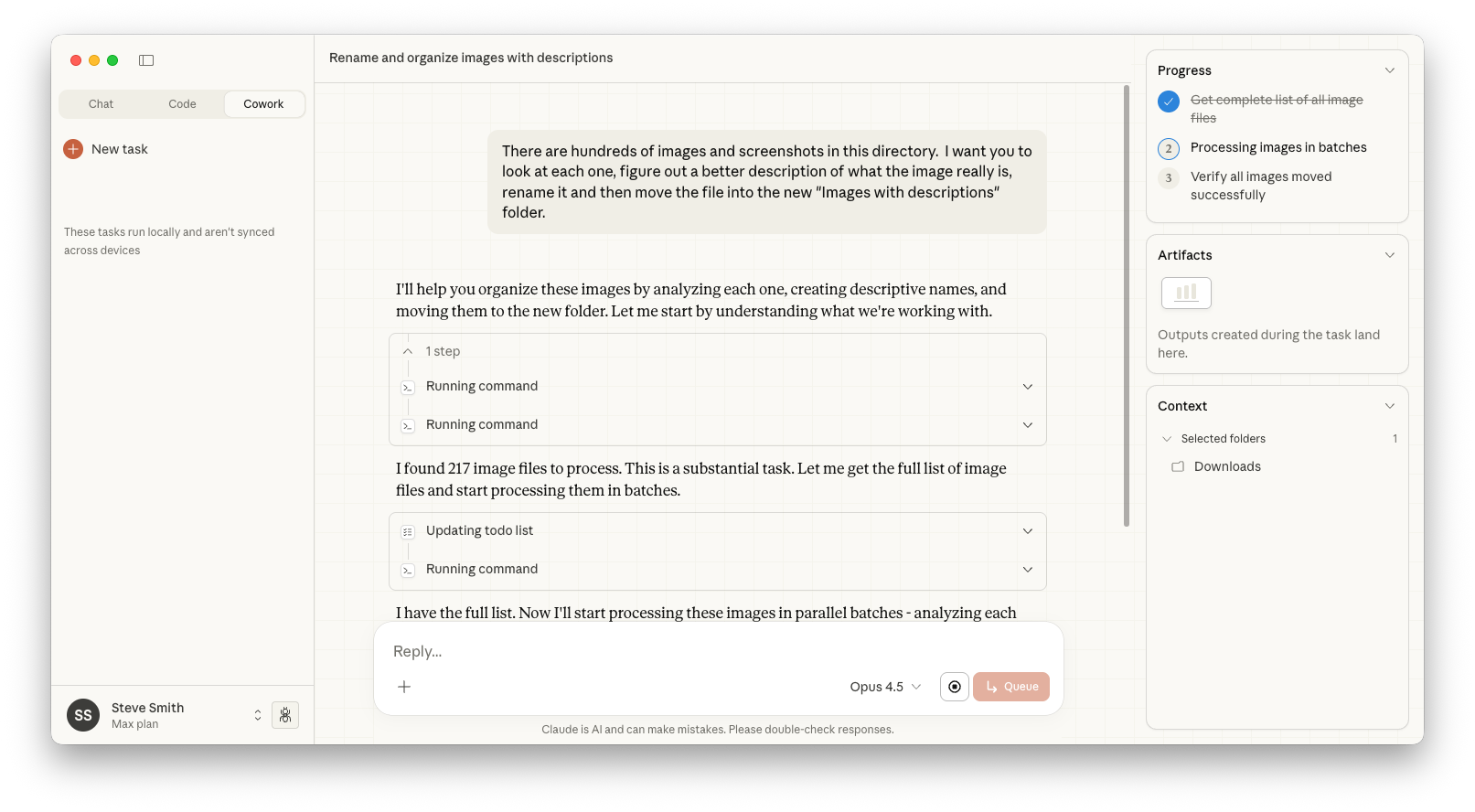
Here’s a perfect example that I just ran. I have hundreds of images and screenshots in my downloads directory, and they have names like “gemini_generated_image_q3jcs…..” I have no idea what they are. So I kicked off Claude Cowork with the following command “There are hundreds of images and screenshots in this directory. I want you to look at each one, figure out a better description of what the image really is, rename it and then move the file into the new "Images with descriptions" folder.” It’s now going through every image and giving each a much better, more descriptive name (like “data-governance-bridge-blueprint-illustration.png”)
The whole thing only took a few minutes to run. Can you imagine how long that would take manually to open each file, figure out a better description, rename it, and move it? Hours and hours saved with one command.
None of that is “AI magic.”
It’s office work. The kind that burns hours and attention.
And that’s why it matters.
Why this packaging matters more than the feature
Most of my clients don’t need another “smart chat.”
They need the model to do the last mile.
That’s what Claude Code proved. Not because people love terminals. Because Claude Code can operate like a general agent:
It can look at a set of files. Make a plan. Take actions. Check its work. Iterate. Pull in outside context when needed. Keep going until it hits a stopping point or a decision it should hand back to you.
That’s the difference between “help me think” and “help me finish.”
Cowork doesn’t invent that idea. It makes it approachable.
And that changes who will use it.
When you wrap an agent in an app, you invite in operators, analysts, marketers, project managers, and exec assistants. People who live in files all day, and who don’t want to learn a new tool just to get the benefit.
So yes, it’s “Claude Code in the app.”
But in product terms, that’s a big move.
The real power is the agent loop
Here’s what I mean by “agent,” in plain English.
A chatbot answers questions.
An agent completes tasks.
An agent is allowed to do things in the world, even if that “world” is just a folder on your machine. It can open a file, extract the useful parts, create a new file, update the old one, and keep a running thread of what it did and why.
That loop is what makes this more than a novelty.
It’s also why you need to treat it with respect.
Because the same loop that makes it useful is the loop that makes it fast at making mistakes.
What this changes for teams
Cowork is going to land hardest in places where the work is repetitive, file-heavy, and easy to verify.
Finance and ops teams. Marketing teams drowning in drafts. Sales ops cleaning lists. Legal teams assembling exhibits and chronologies. Anyone who spends an hour a day turning messy inputs into clean outputs.
The immediate win isn’t “AI intelligence.”
It’s time and attention.
If Cowork saves someone 30 minutes a day, that’s about 2.5 hours a week. Roughly 10 hours a month. Over a year, it’s the difference between being underwater and being ahead.
But there’s a second-order win too: standardization.
Once you can say “do this the same way every time,” you start to reduce variation. Less rework. Fewer missed steps. Fewer “why did we name it like that” debates.
That’s how you get real productivity, not just faster drafts.
The risks and tradeoffs you can’t ignore
Two risks matter right away.
First, destructive actions. If an agent can edit files, it can also break files. Even with guardrails, “close enough” is not good enough when it’s touching the wrong document or overwriting the wrong version.
Second, instruction traps. Any system that reads outside content, especially web content, can be nudged by malicious or misleading instructions hidden in what it reads. Even without malice, a messy input can cause the agent to infer the wrong goal.
So treat Cowork like a capable junior teammate with access to your shared drive.
Capable. Fast. Also literal. Also sometimes overconfident.
That’s not a reason to avoid it. It’s a reason to deploy it like an adult.
What I’d do Monday morning
Pick one low-risk workflow. Start with something boring and checkable, like turning receipts or screenshots into a table, renaming files, or drafting a weekly status update from notes.
Create a dedicated “agent folder.” Put only what the agent needs in it. No sensitive client data. No crown jewels. Keep the blast radius small.
Write one page of rules. What “done” looks like, what it must not do, and when it has to ask before taking an action.
Add a review step for anything that leaves the building. If it’s client-facing, money-related, or legally meaningful, a human signs off. Every time.
Measure time saved versus rework created. If it saves 45 minutes but costs 30 minutes to fix, you didn’t win. You just moved effort around.
Do that for two weeks, and you’ll know if Cowork is a toy or a tool for your team.
The part that should make every exec sit up
One detail floating around this launch is the build velocity. The story is that Cowork came together in roughly a week and a half, and that Claude Code itself did a large share of the coding (rumor is 100%).
Whether that’s “most” or “all” matters less than the direction.
AI is speeding up the creation of AI-powered products.
That loop compounds. Fast.
So the headline isn’t just “Anthropic shipped a new feature.”
The headline is that agent tooling is moving from niche to normal, and it’s moving faster than most organizations’ ability to adapt their workflows and controls.
Cowork is Claude Code made easy.
And the minute it’s easy, it spreads.
Why I write these articles:
I write these pieces because senior leaders don’t need another AI tool ranking. They need someone who can look at how work actually moves through their organization and say: here’s where AI belongs, here’s where your team and current tools should still lead, and here’s how to keep all of it safe and compliant.
In this article, we looked at the gap between AI that helps you think and AI that finishes the task. Agent tools like Cowork are crossing that line, and most organizations aren’t ready to manage what happens when the model can touch files instead of just talk about them. The market is noisy, but the path forward is usually simpler than the hype suggests.
If you want help sorting this out:
Reply to this or email me at steve@intelligencebyintent.com. Tell me what’s slowing your team down and where work is getting stuck. I’ll tell you what I’d test first, which part of the Claude agent stack fits your use case, and whether it makes sense for us to go further than that first conversation.
Not ready to talk yet?
Subscribe to my daily newsletter at smithstephen.com. I publish short, practical takes on AI for business leaders who need signal, not noise.