


The Five Modes of AI Work: Why Most Law Firms Are Stuck at Two
TL;DR: AI in law firms is moving from a thing you ask to a thing you delegate to. There are five modes of use, from simple Q&A to running fleets of agents. Most firm professionals are stuck at modes 1 and 2. The early adopters are reaching mode 3. Modes 4 and 5 are where the operating model actually changes, and the trajectory is hitting different roles at very different speeds. Assistants and finance teams have a 12 to 24 month window. Paralegals are looking at hard repositioning inside two years. Lawyers are insulated by judgment but transformed by expectation. The firms that win won’t be the ones with the biggest tech budgets. They’ll be the ones whose people are furthest up the ladder.
A conversation that’s becoming familiar
I had a call last week with a managing partner who told me, “We’re all in on AI.” I asked what that looked like in practice. He said his associates were using Claude and ChatGPT for first drafts. His paralegals were summarizing depositions. His marketing team was running a couple of automations.
I didn’t say it out loud, but here’s what I was thinking: that’s the easy part. That’s not the part that changes the firm.
The chatbot era of AI was about substitution. Use AI instead of Google. Use AI instead of a blank page. It made each individual worker faster at doing the same job. That’s real value, and I don’t want to dismiss it. But it doesn’t change the shape of how a firm operates.
What’s coming next is different. AI is moving from a thing you ask to a thing you delegate to. Not faster Google. More like a junior colleague who can be told “handle this.” That’s the shift. And it’s already happening, unevenly, across the roles that make up a typical firm.
The five modes of AI work
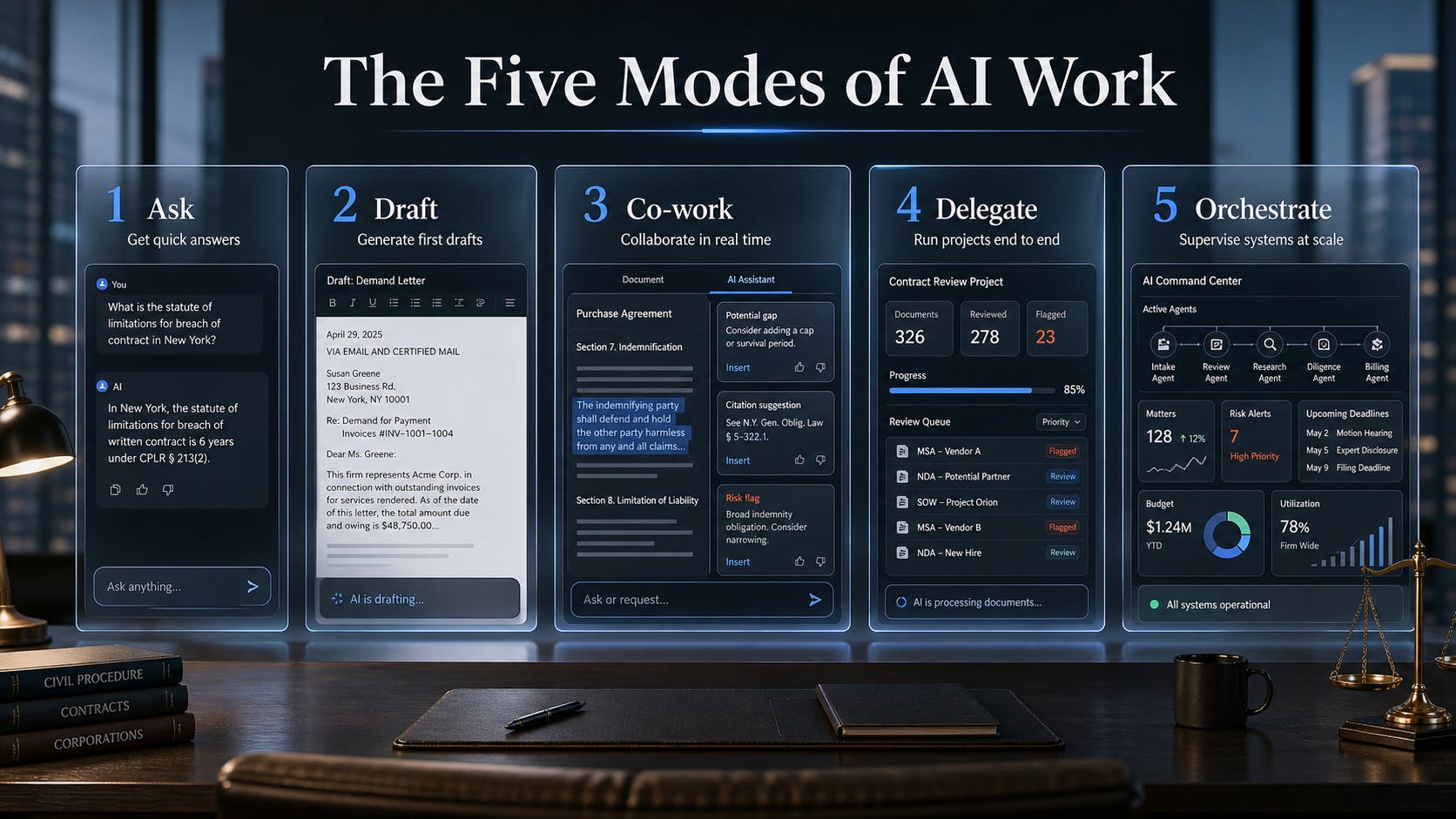
Here’s the frame I use. Across the research I’ve seen and the work I’ve done with firms, the same trajectory keeps showing up under different names. This is the cleanest version.
Ask. Information retrieval. “What’s the statute of limitations in California for breach of contract?”
Draft. Content generation. “Write me a first-draft demand letter for this wage-and-hour claim.”
Co-work. You give AI a goal and it executes against it, browsing, drafting, pulling files, organizing, until there’s an outcome to look at. You can watch it run and redirect mid-flight, but you’re not driving every step. “Research the leading New York cases on tortious interference over the last five years. Pull the key holdings into a one-page memo and drop it in the matter folder.”
Delegate. You hand off a discrete project end to end. AI runs the work, you audit and refine. “Run the full first-pass review of these 2,400 documents against the privilege log criteria we discussed. Flag anything borderline and give me a summary.”
Orchestrate. You design and supervise systems where AI agents run processes from start to finish. “Monitor every active matter for deadline risk and budget variance. Run weekly status updates, escalate anything that needs human judgment, and keep the dashboards current.”
Most firm professionals are doing modes 1 and 2 today. The early adopters are reaching mode 3. Mode 4 is technically possible right now, but rare in practice, because firms haven’t built the trust, the governance, or the workflows for it. Mode 5 exists in pockets. E-discovery vendors. Some billing automation. But it’s years from being typical for most firms.
The thing to understand is that each step up the ladder isn’t just “more capable AI.” It’s a different relationship between the worker and the work. At mode 2, you’re a writer using a tool. At mode 4, you’re a director reviewing somebody else’s draft, except the somebody else is the AI. A writer produces. A director judges, chooses, rejects, sends it back. Those aren’t the same job, and the skills that make somebody great at one don’t automatically carry over to the other. Neither does the staffing math, the training program, or honestly what a good day at work feels like. Most firms haven’t sat with that yet.
How the modes land in different roles
Here’s where the strategic implications start to bite. The trajectory isn’t moving at the same speed across every role. That asymmetry is the part most firms get wrong when they plan training and staffing.
Legal assistants and secretaries
This group is both the most exposed and the best positioned to benefit. Their core work today, scheduling, formatting, intake, document binders, routine correspondence, is exactly the bounded, system-driven work that mode 4 handles well.
But “exposed” doesn’t mean “redundant.” The path forward isn’t fewer assistants. It’s assistants who run AI systems that handle the volume work, freeing them up for relationships, exceptions, and the higher-judgment tasks they were never given enough time for. Twelve to eighteen months from now, the assistants who adapt will be running small fleets of automations. The ones who don’t will be doing the same work as today, just compressed into less of the day. That’s a worse position to be in, not a better one.
Finance and billing
Same story, slower clock. Time entry narratives, invoice generation, A/R follow-ups, profitability analysis, rate card enforcement, client guideline compliance. All of it is moving from mode 2 (AI helps the analyst) to mode 4 (AI runs the workflow, the analyst supervises).
The blocker isn’t capability. It’s trust, integration with practice management systems, and partner buy-in. Two-year horizon for finance teams to shift from running invoices to designing the workflows that run them.
The real promise here isn’t cost reduction. It’s that finance stops being a backward-looking reporting function and starts being a real-time business advisor. Instead of “here’s last month’s realization,” finance can say, “this matter is trending eighteen percent over budget, here are the likely causes, here are three interventions.” That changes the role’s value to the firm.
Paralegals
This is the hardest conversation in the firm. First-pass document review, summarization, deposition prep, citation checking, chronology building. Everything that fills a junior paralegal’s day is already mode 3 work and is moving toward mode 4.
The good news: paralegals who become AI orchestrators, designing review protocols, validating output, running case workflows, become more valuable, not less. The bad news: routine paralegal hours billable to clients are going to compress, and they’re going to compress fast.
Two-year horizon is when this gets uncomfortable for firms that haven’t repositioned the role. Repositioning doesn’t mean turning paralegals into lawyers. It means evolving them into matter intelligence specialists whose value is structuring the work, validating sources, maintaining evidence integrity, and catching what the model misses.
Lawyers
Most insulated. Most changed.
Insulated because judgment, advocacy, client trust, and strategy don’t delegate well to AI yet, and won’t anytime soon. The professional rules require a human in the loop, and recent sanctions over AI-generated filings have made it clear that “I trusted the tool” isn’t a defense.
Changed because the work product lawyers are expected to produce will increasingly start as AI output they shape, not blank pages they fill. Within three years, a lawyer who can’t direct an AI workflow that produces a first-draft brief, research memo, or deal summary is going to be working at a meaningful disadvantage to one who can.
And here’s what I want firm leaders to hear most clearly. The skill isn’t “using AI.” The skill is knowing what good output looks like and being able to spot what’s wrong with the AI’s draft. That skill takes years to build. Which is exactly why partners can’t afford to skip it themselves and just push it down to associates.
The asymmetry, on one screen
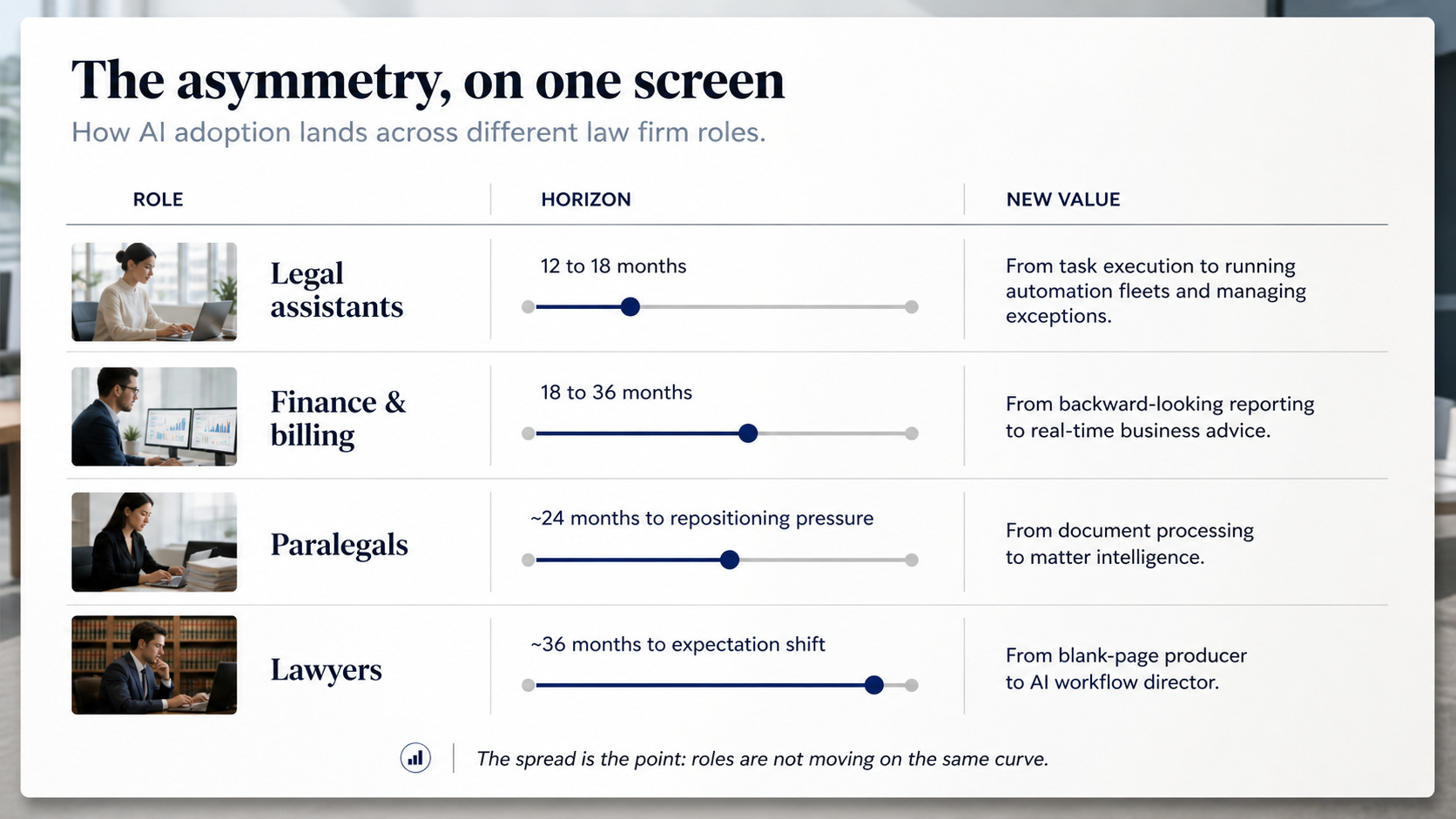
Role Horizon and new value Legal assistants 12 to 18 months. From task execution to running automation fleets and managing exceptions. Finance and billing 18 to 36 months. From backward-looking reporting to real-time business advice. Paralegals 24 months to repositioning pressure. From document processing to matter intelligence. Lawyers 36 months to expectation shift. From blank-page producer to AI workflow director.
None of those numbers are precise, and I’d argue with anybody who claims theirs are. But the spread between them is real. Plan training, hiring, and pricing as if all four roles are on the same curve and you’ll mis-staff every part of the firm at once.
The training trap
The biggest mistake I see firms make is treating AI training as a one-time event. A vendor comes in, runs a two-hour CLE on prompt writing, hands out a tip sheet, and leaves. I’ve sat in plenty of these. They don’t work, and the reason isn’t really the vendor.
The half-life of any specific tool skill is now under a year, maybe less. UIs change. Models change. New products launch and old products absorb their features within a quarter. If you train your firm on the version of Claude or ChatGPT that exists today, half of what you taught is going to be wrong by the time the partners actually get around to using it.
What doesn’t change is the underlying skill stack. Workflow design, output evaluation, verification discipline, governance literacy. That’s the short version. The longer version is that workers need to know which tasks are safe to automate (and which aren’t), how to spot AI being confidently wrong, how to verify outputs against actual sources, and how to stay on the right side of confidentiality and the rules of professional conduct. None of that goes away when the next model ships.
The firms doing this well don’t run quarterly seminars. They run internal communities of practice, do monthly use case reviews, and carve out protected time for people to actually experiment. They treat AI capability as something the firm builds, not something it buys. The firms doing it badly are buying licenses and hoping people figure it out, which works about as well as you’d think.
How fast, and where this is going
I want to be honest about something. The time horizons people quote, mine included, are guesses. Anyone telling you with confidence what the firm of 2030 looks like is selling something.
What’s not a guess is the trajectory. The modes are real. The role-by-role asymmetry is real. The firms that adapt fastest won’t necessarily be the ones with the biggest tech budgets. They’ll be the ones whose people are furthest up the ladder, with the trust and governance to operate there.
My rough estimate, and you should hold it loosely: five years before the operating model of a mid-sized firm looks meaningfully different from today. Three years before staffing math starts to bend. Twelve months before the firms that have done the work pull visibly ahead of the ones that haven’t. Some firms will move faster than that. AmLaw 20 firms with mature governance, and specialized boutiques where the partners themselves are already using these tools daily, are running a year or two ahead of the curve. The variance across the industry is going to widen before it narrows.
What to do Monday morning
If you run a firm or a practice group, here’s where I’d start.
Run an honest audit of where your people actually are on the modes ladder. Survey by role: what mode are most of your assistants, paralegals, finance staff, and lawyers operating in today? You’ll find more variance than you expect. The gap between your most adapted person and your least is itself a strategic risk, especially if the most adapted ones are lateral hires you can’t afford to lose.
Pick one workflow per practice group to push to mode 4. Just one. Something bounded, low-risk, and high-volume, like a pre-bill review process or a closing checklist or a litigation status packet. The temptation will be to pick five things at once. Don’t. Run the one as a real pilot, with real metrics, and treat the lessons it surfaces as more valuable than the productivity gains.
Replace AI training with an AI practice program. Less classroom. More monthly use case sessions, paired work, and protected time for people to experiment without billing pressure. The vendors will sell you a curriculum. You don’t need a curriculum. You need a culture that treats getting better at AI as part of the job.
That’s the whole list. I know it sounds underwhelming after all the talk about modes and ladders and asymmetric timelines. But most firms aren’t suffering from a strategy gap right now. They’re suffering from a starting gap. Don’t let a vendor talk you into a transformation roadmap before you’ve done the audit.
The line that should stick
In the chatbot era, the question was: what should I ask?
In the era we’re entering, the question is: what should I delegate, what should I verify, and what should I never let a machine decide alone?
The firms that figure that out first will look very different from the ones that don’t.
The chatbot era taught firms how to ask better questions. The era we're entering asks something harder of firm leaders: knowing what to delegate, what to verify, and what to never let a machine decide alone. The firms that figure that out first will look meaningfully different from the ones that don't, and the gap is opening faster than most partners think. If you're working through what this means for your training, your staffing, or your pricing model, I'd genuinely like to hear what you're seeing. Reach me at steve@intelligencebyintent.com.