
Your Claude Project Holds Far More Than It Reads
TL;DR: Claude projects accept an “unlimited” number of files, and once you pass the context window they switch to retrieval, which expands capacity by up to ten times. Both numbers are real. They measure different things. A project can hold north of six thousand pages while considering six hundred to twelve hundred of them at a time. Storage went up. Attention didn’t.
The complaint I keep hearing
The pattern shows up the same way every time. A firm loads four years of engagement letters, a pile of transcripts, and every closing checklist anyone can find into one project. Nothing breaks. Then the answers start going soft, and one day somebody notices that Claude missed language sitting in a document they uploaded themselves.
The interface never complained. It said unlimited, so they treated it as unlimited.
What happened there is worth understanding, because the fix is arithmetic rather than a support ticket.
Two numbers, and people only ever hear one
Claude projects cap files at 30MB each and put no cap on how many you upload. That second number is the one everybody repeats. It’s also the one that means the least.
What runs your project is the context window. That’s how much Claude holds in front of it at one time. On the current models, chatting on a paid plan, you get a million tokens. Older ones run at half or a fifth of that.
A token is a fragment of a word. Anthropic puts it at roughly three and a half characters. That’s well short of the “three quarters of a word” rule people still quote, and the newest models make it worse. They tokenize about thirty percent heavier than the ones before them. Same text, thirty percent more tokens. So a million tokens buys you closer to six hundred thousand words than the seven hundred fifty thousand the old rule promises.
Then subtract working room. Project instructions, the conversation itself, any connectors you’re running, and Claude’s own answers all pull from the same pool. I budget about seventy percent of the window for documents. That’s my rule of thumb, not a published figure.
Count pages, not megabytes
Here’s where I have to be honest about how soft this arithmetic is.
A single-spaced page of business or legal prose runs around 500 words. That page costs somewhere between 600 and 1,100 tokens, depending on which of Anthropic’s published figures you run it through. Deposition pages are lighter, 350 to 550, depending on how much of each line the testimony actually fills.
Run that against a 700,000 token working budget and you get 600 to 1,200 pages that Claude can hold in view at once. Cross that line and retrieval takes over, lifting capacity by as much as ten times.
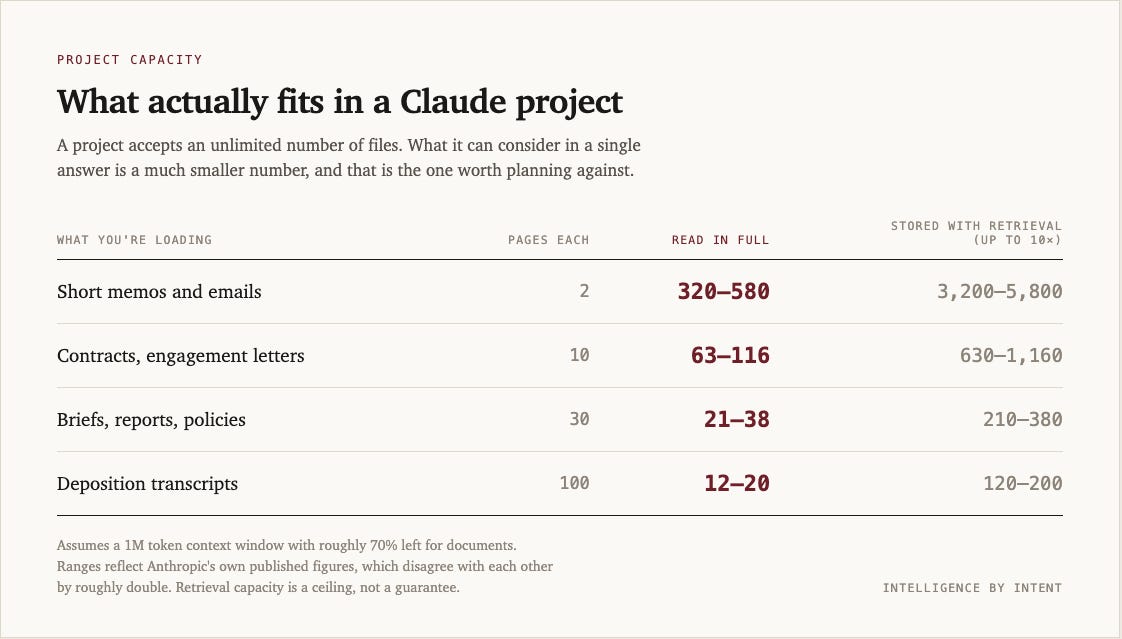
Those ranges are wide and I’m leaving them wide. Anthropic publishes a page-count heuristic in one place and a character-per-token definition in another. Do the math both ways and the answers differ by roughly double. Anyone handing you a single confident number for this is doing arithmetic on sand. Plan against the low end.
Now compare any of it to the 30MB file cap everyone quotes. A megabyte of extracted text runs around 300,000 tokens, more on the newer models. Three text files could fill the entire window without any of them coming near the cap. Meanwhile a long scanned PDF might contribute nothing at all, because past 100 pages Claude drops to text only, and a scan without a text layer has no text to pull.
Megabytes describe storage. Pages describe attention. Only one of those is scarce.
Holds is not the same as reads
When your project crosses the line, Claude stops loading everything and starts searching. It uses a project knowledge search tool, pulls back the passages that look relevant, and answers from those. There’s an indicator when this happens. Almost nobody notices it.
Anthropic’s position is that quality holds steady through the switch. For a large share of what people do with projects, I think that’s right. Ask “what does the indemnity clause say in the Henderson agreement” and retrieval is the better tool. It’s faster and it doesn’t waste the window.
But ask “compare the indemnity language across all 40 of these agreements and tell me which three are outliers” and something different is happening. Retrieval decides what Claude sees before Claude reasons about it. The mechanism predicts that comparison and synthesis suffer in ways lookup doesn’t. The answer comes back in the same confident register either way, so you get no signal telling you whether it looked at 40 agreements or 6.
So test it. Ask Claude to name every document it consulted, then check that list against what you thought you asked about.
That firm’s project hadn’t broken. It had been promoted to a search tool without anyone asking.
The objection, which is fair
Someone always says: fine, so cap every project at a thousand pages, and now I’m managing capacity instead of doing work.
That’s not the tradeoff. Retrieval is genuinely better for reference material. If you’re building a project that holds your clause bank, your brand guidelines, your onboarding docs, the whole point is lookup, and you should blow past a thousand pages without a second thought. That’s what the ten times is for.
The question isn’t size. It’s whether the task needs Claude to see everything at once. Most firms build one giant project, use it for both kinds of work, and can’t explain why the answers vary. The pull runs one direction, too. A project you like is a project you keep feeding.
Splitting is cheaper than people assume. Each project gets its own capacity, so a second one starts with a fresh budget instead of eating into the first. What splitting costs you is routing. Somebody has to know which project holds the answer, and in a firm that somebody is usually the associate who wasn’t there when the projects were set up.
What to do Monday morning
Convert one project to pages. Take your most-used project, add up the page count, and put it against the 600 to 1,200 range. You’ll either feel fine or you’ll feel something drop.
Split by job, not by client. Keep one deliberately small project for work that needs full reading. Let the reference project be enormous.
Rename your files like an index. Once retrieval is running, file names are how Claude decides where to look. “Smith_MSA_2024_indemnity.pdf” gets found. “Document (3) final FINAL.pdf” does not.
Unlimited uploads are not unlimited attention. Your project will always accept the next document. It just stops reading them all at some point, and it won’t tell you when.
If you enjoyed reading this, please share with others.
Here’s a shot of Magnus from yesterday sitting in the yard, waiting patiently to go on a walk.