


Most Law Firms Live in Two Modes of AI. There Are Five.
TL;DR: There are five modes of AI work: Ask, Draft, Co-work, Delegate, Orchestrate. Most law firms operate in the first two. Microsoft’s 2026 Work Trend Index, published May 5, found that the most advanced AI users are producing 22 percentage points more output than typical users, and that two-thirds of that gap comes from organizational design rather than individual talent. The capacity is sitting unclaimed because most firms haven’t built the systems to capture it.
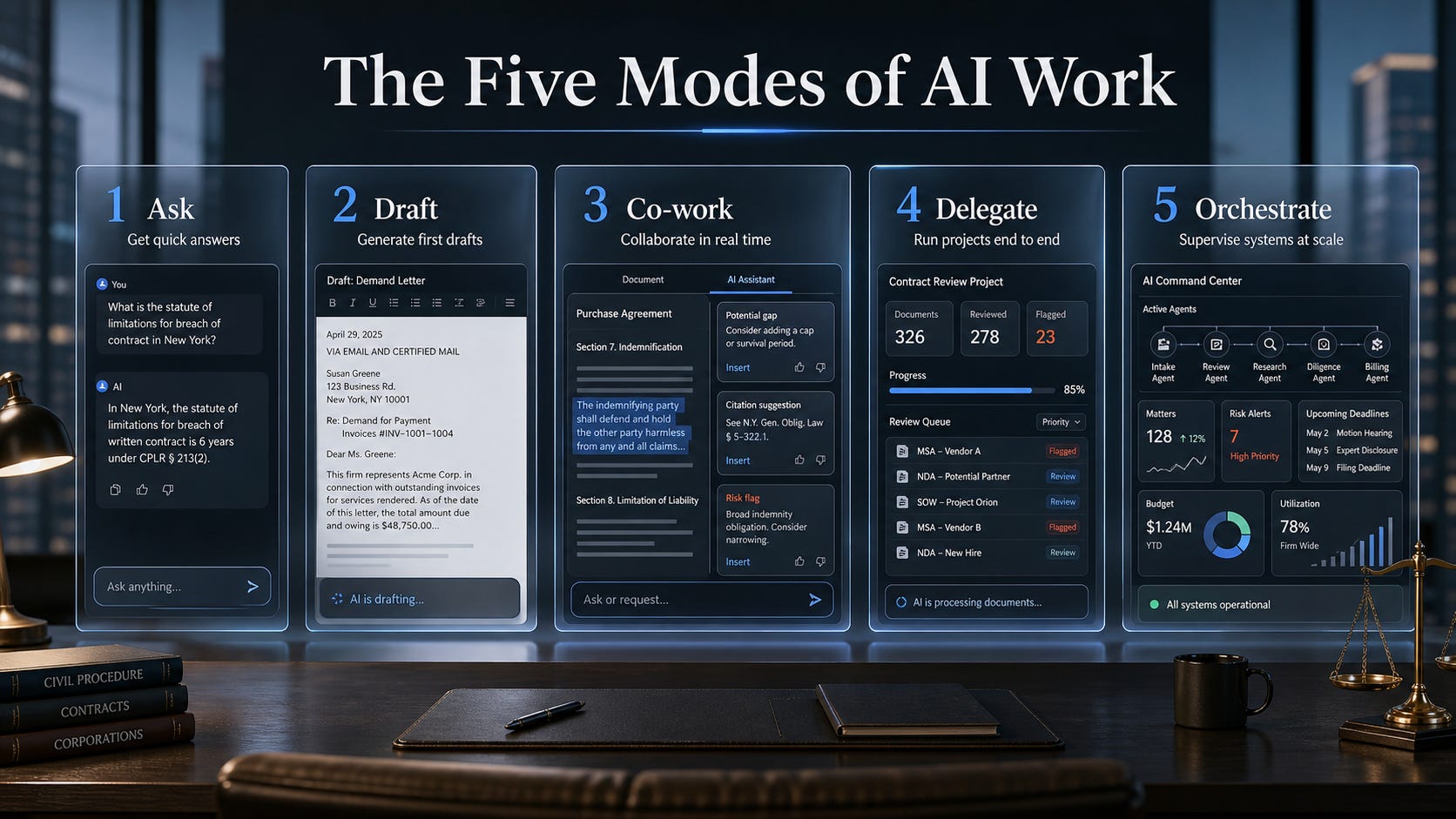
I’ve been giving a version of the same talk for the last six months. Different rooms, different cities, different firms. The slide that lands hardest is the one with five modes of AI work on it. Ask, Draft, Co-work, Delegate, Orchestrate.
I show it. I walk through it. Then I ask the room which mode their attorneys actually operate in.
The answer is almost always the same.
The first two.
On May 5, Microsoft published its 2026 Work Trend Index. Trillions of M365 productivity signals. 20,000 AI users surveyed across ten countries. The closest thing the industry has to a definitive read on how people actually work with AI right now.
Two findings stop me cold every time I revisit the report.
First. 58% of all AI users say they’re producing work they couldn’t have done a year ago. Among the most advanced users (Microsoft calls them Frontier Professionals, defined by their use of multi-step agent workflows, multi-agent systems, and routine workflow redesign), that number jumps to 80%. Twenty-two points. Same tools. Same training programs available to anyone who asks. The difference is which modes those people actually use, and how often.
Second. Microsoft tested a long list of factors against AI impact. Individual mindset, AI familiarity, job level, generation, market, industry. Then organizational stuff: culture, manager support, talent practices. Want to know which side won?
Organizational factors accounted for 67% of the variation. Individual mindset and behavior, 32%.
Two times the impact. From the system around the person, not the person.
That second number should keep firm leaders up at night. The question isn’t “are my people good with AI.” It’s “have we built a place where good AI work is possible.” Most firms have not. Most firms haven’t even tried. Most firms are still treating AI like Westlaw with a chat interface.
Let me show you what I mean.
The Five Modes
1. Ask. You open a tab, ask a question, get an answer, close the tab. Statute of limitations on breach of contract. Holding in a case. The drive-by use of AI. Most attorneys live here.
2. Draft. You feed AI a starting set of facts and let it produce the first version. A demand letter. A first cut at an indemnification clause. You edit. You take ownership. The model does the heavy lifting on the page; you do the thinking on the substance. A lot of attorneys have started living here too.
3. Co-work. You’re in the document. AI is working alongside you, pointing things out as you go. Section 7’s indemnification language is unusual, here’s the cite. Section 8’s limitation of liability is broader than what’s standard in this industry. AI sitting next to you, watching, suggesting, citing. You’re still driving. You just have a much smarter passenger.
4. Delegate. You hand AI a project and walk away. Review these 326 contracts and flag the unusual ones. Run diligence on this target. Build the closing checklist and pull documents into the data room. AI runs end to end. You review the output, not the process. This is the mode that requires real infrastructure: validated outputs, human checkpoints, audit trails.
5. Orchestrate. You’re supervising a system of agents handling different pieces of the practice in parallel. Intake. Review. Research. Diligence. Billing. Each agent autonomous, all coordinated. The lawyer’s job becomes architecture and quality control.
Where Most Firms Actually Live
Modes 1 and 2. That’s the whole footprint.
This isn’t a guess. It’s the consistent finding from every law firm leader survey I’ve seen for the last year, and it’s consistent with what Microsoft just published. Most users sit in low-intensity patterns. Most organizations haven’t built the systems to support higher-intensity use. Microsoft’s data tells you what that costs: 22 percentage points of additional output, sitting unrealized because the system around the user wasn’t designed to support it.
Now think about what staying in modes 1 and 2 means at a firm level. Faster legal research. Faster document drafts. The 10 to 15% efficiency lift that almost everyone gets from baseline AI use.
Helpful. Your competitors get the same lift. Net difference: zero.
The capacity gain is in modes 4 and 5. Work that used to take three associates a week now takes one and a smart workflow. Routine review pipelines that used to run on weeks-long cycles run overnight. Honestly, it stops looking like lawyering as the profession recognizes it. The work is still legal work. The cost structure for delivering it is something firms in modes 1 and 2 can’t price against.
Mode 5 Is Not Theoretical Anymore
A year ago, Mode 5 was a slide in a deck. It’s not anymore.
Harvey put 500-plus pre-built legal agents into early access on May 5, the same day Microsoft published its report. Slaughter and May, the magic circle firm, announced a firmwide Harvey rollout on April 29 covering M&A, due diligence, regulatory research, and document analysis. Manifest OS, which closed a $60 million Series A at a $750 million valuation in late April, runs an AI-native immigration practice posting visa approval rates 15% above the national average and client response times three times faster than traditional firms.
These are different shapes of business. Smaller staffing pyramids. Different fee structures. Different output at different price points. The fact that they exist right now, posting measurable outcomes, is the part most firm leaders haven’t reckoned with yet.
Why Firms Stay Stuck
Three reasons. They wrap around each other so tightly that pulling at one without dealing with the others tends not to work.
The first is trust. Most attorneys don’t trust an AI’s first draft enough to take it as a starting point, much less hand off an entire project. Fair enough. They’ll get there or they won’t. Time and exposure to good outputs handle this one over the next twelve months.
The second is billing. This is the uncomfortable one. If your firm bills by the hour and Mode 4 lets your associates produce in one-quarter of the hours, you have a revenue problem disguised as a productivity win. The math is brutal. You either bill less for the same work, or you find a way to capture the value of finishing faster, which means alternative fee arrangements, fixed pricing, value-based scopes, anything that decouples revenue from time spent. The profession has been talking about this since at least 2010 and most firms still haven’t solved it. The market is now going to solve it for them, one client conversation at a time. The firms that haven’t sorted this out have a structural incentive to keep their associates in modes 1 and 2, where AI helps but doesn’t compress the hours billed. They won’t say that out loud. They don’t have to. The behavior tells you.
The third is training. Almost every AI training program I see in law firms teaches people how to prompt and which buttons to click. Almost none teach people how to specify a piece of work in a way an AI can execute, how to evaluate AI output against a quality standard, or how to architect a workflow that uses AI well. That’s the gap between Mode 2 and Mode 4. It’s a training problem, not a tools problem. A firm could close it in a quarter if it decided to.
What to Do Monday Morning
Three things, in order.
One. Pick five attorneys at different levels and ask them, in detail, how they used AI in the last week. Listen for the mode. If everything you hear is in modes 1 and 2, you have your answer about where your firm actually operates.
Two. Pick one practice area and one workflow inside it that’s a candidate for Mode 4. Contract review. Due diligence. Intake. Anything routine and high-volume. Build the case for what it would take to move that workflow from Mode 2 to Mode 4. What evaluation criteria. What human checkpoints. What infrastructure. Don’t try to boil the ocean. Pick one workflow.
Three. Have the billing conversation. Honestly. With your finance partner, with your practice group leaders. If you successfully move work into Mode 4 and your associates produce in one-quarter of the time, what is your fee structure on that work? If you don’t have an answer, you have a structural disincentive to actually move up the modes. Solve that or stay where you are.
The Punchline
Microsoft’s data shows the gap exists right now. Not theoretically, in 2027 or 2030. Right now, in the data they collected between February and April of this year. Firms operating in modes 1 and 2 are getting one return on their AI spend. Firms in modes 4 and 5 are getting a meaningfully different one.
You can keep telling yourself you’re doing AI because your associates use it for research. Or you can look at where your firm actually operates and decide whether you’re satisfied with where the data says that path ends.
The five-mode map is a diagnostic, not a destination. The firms moving from mode two to mode four aren't working with smarter people or fancier tools. They've built different systems, asked different questions, and had the billing conversation their competitors are still avoiding. If you want to figure out where your own firm sits on this map, or what it would take to move it, that's a conversation I'm always up for. Reach out: steve@intelligencebyintent.com. The firms that own this decade are deciding right now what they're willing to build.